Most people in India use the words honing and sharpening as if they mean the same thing. They don’t. Honing straightens an edge that is still there. Sharpening grinds away steel to make a new edge when the old one is worn out.
This guide explains what honing is, the real difference in honing vs sharpening a knife, how often to do each, and which tool you need for your knives.
Affiliate disclosure: Some links on this page are Amazon.in affiliate links. If you buy through them, I may earn a small commission at no extra cost to you. Read the disclosure.
Short Answer: Honing vs Sharpening
Honing pushes a bent or rolled edge back into a straight line using a honing rod. It removes little or no metal and takes about 30 seconds. Sharpening grinds metal off the blade on a stone or sharpener to create a brand-new edge. Hone often to keep a knife cutting well; sharpen only when honing no longer brings the edge back.
| Honing | Sharpening | |
|---|---|---|
|
What it does |
Realigns a bent or rolled edge |
Grinds a new edge |
|
Metal removed |
None or very little |
Yes, a thin layer |
|
Tool |
Steel or ceramic honing rod, leather strop |
Whetstone, pull-through, electric or diamond sharpener |
|
Time taken |
About 30 seconds |
5 to 20 minutes |
|
How often (home use) |
Every 2 to 4 uses |
Every 2 to 4 months |
|
Fixes chips or a worn edge? |
No |
Yes |
What Is Honing?
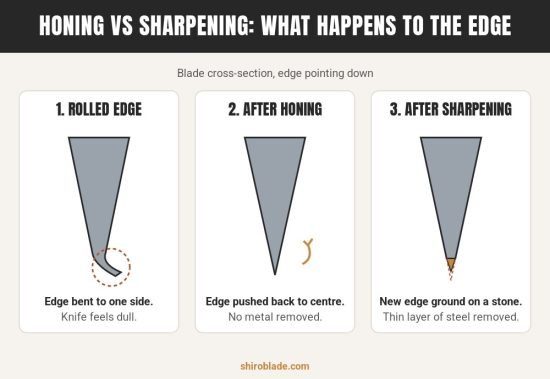
Honing is the process of straightening the edge of a knife without grinding a new one. A knife edge is extremely thin, only a few microns wide at the very tip. Each time it hits a steel plate, a granite counter or a chicken bone, that thin edge bends to one side. The knife feels dull even though the edge is still there.
A honing steel (also called a honing rod or sharpening steel) pushes that bent edge back to the centre. That is why a few strokes on a rod can make a knife feel sharp again in seconds.
Types of Honing Rods
| Rod type | Removes metal? | Best for |
|---|---|---|
|
Grooved steel rod |
No, only realigns |
Softer German and Indian stainless knives (54 to 58 HRC) |
|
Smooth steel rod |
No |
Gentle daily touch-ups |
|
Ceramic rod |
Yes, a very small amount |
Harder Japanese knives (58 to 62 HRC) and most budget knives |
|
Diamond-coated rod |
Yes, quite a lot |
This is really a sharpener, not a hone; use it rarely |
|
Leather strop |
No, it polishes |
Finishing a freshly sharpened edge |
HRC is the Rockwell hardness of the steel. Very hard Japanese blades can chip on a grooved steel rod, so a ceramic rod or a strop is the safer choice for them.
What Is Sharpening?
Sharpening removes a thin layer of steel from both sides of the blade until the two sides meet in a new, clean edge. You need it when the edge is actually worn down or chipped, not just bent. No amount of honing will fix a worn edge, because there is nothing left to straighten.
Sharpening tools work like sandpaper. A coarse surface (around 200 to 400 grit) removes metal fast and repairs chips. A medium surface (around 1000 grit) sets the edge. A fine surface (3000 grit and above) polishes it. Our guide on the 7 types of knife sharpeners compares each tool in detail.
Honing vs Sharpening a Knife: Side-by-Side Comparison
| Factor | Honing | Sharpening |
|---|---|---|
|
Purpose |
Maintenance |
Repair and restore |
|
Effect on blade life |
Almost none |
Each session shortens the blade slightly |
|
Skill needed |
Low |
Low (pull-through) to medium (whetstone) |
|
Typical price in India |
₹300 to ₹1,500 for a rod |
₹300 to ₹3,000 for a stone or sharpener |
|
Works on serrated knives? |
Only with a thin tapered rod |
Only with a tapered rod or a serrated slot |
|
When the knife needs it |
Feels a little dull, slips on tomato skin |
Still dull after honing, or has chips |
Think of it like a car. Honing is checking the tyre pressure every week. Sharpening is replacing the tyres when the tread is gone. Doing the first regularly means you need the second far less often.
How to Tell Whether Your Knife Needs Honing or Sharpening
- Do the tomato test. Rest the edge on a ripe tomato. A sharp knife bites into the skin with almost no pressure. If it slides off, the knife needs attention.
- Hone first. Give it 5 to 6 light strokes per side on a honing rod.
- Test again. If it now cuts the tomato cleanly, honing was all it needed.
- Still dull? Sharpen. If it still slips, or you can see shiny spots or chips on the edge under a light, the edge is worn and needs sharpening.
How to Hone a Knife in 4 Steps
1. Hold the Rod Upright
Place the tip of the rod on a folded kitchen towel on the counter and hold it vertically. This is safer than the chef-style method of swinging the knife in the air.
2. Find the Angle
Hold the knife at about 15° to 20° to the rod. Most Western and Indian kitchen knives are around 20° per side; Japanese knives are usually closer to 15°. A simple trick: 90° is straight out, half of that is 45°, half again is about 22°. Tilt a little lower from there.
3. Pull Down and Across
Start with the heel of the blade at the top of the rod and pull the knife down and towards you so the whole edge, heel to tip, touches the rod in one smooth stroke. Use very light pressure, about the weight of the knife itself.
4. Alternate Sides
Repeat on the other side of the rod. Do 5 to 6 strokes per side, then wipe the blade clean. More strokes do not help; light and even beats hard and fast.

How Often Should You Hone and Sharpen?
| How you cook | Hone | Sharpen |
|---|---|---|
|
Daily cooking for a family |
Every 2 to 3 uses |
Every 2 to 3 months |
|
A few times a week |
Once a week |
Every 4 to 6 months |
|
Heavy use (meat, pumpkin, coconut) |
Before each session |
Every 1 to 2 months |
|
Hard Japanese knife (60+ HRC) |
Strop or ceramic rod weekly |
Every 4 to 6 months |
Use these as a starting point and let the tomato test decide. Cutting on a soft wooden chopping board instead of a steel plate or granite also keeps the edge straight for much longer.
Common Mistakes with Honing and Sharpening
- Using a rod on a dull knife and expecting miracles: honing cannot rebuild a worn edge.
- Pressing hard on the rod: heavy pressure bends the edge again or chips harder steel.
- Changing the angle every stroke: this rounds the edge. Keep your wrist locked.
- Using a diamond rod daily: it removes metal every time and wears the blade down quickly.
- Running a grooved steel on a hard Japanese knife: use a ceramic rod or strop instead.
- Cutting on steel plates or glass boards: these roll the edge in a few cuts. See our notes on steel cutting boards.
Which Tool Should You Buy?
For most Indian home kitchens, the best setup is simple: one ceramic honing rod for weekly touch-ups and one combination whetstone (1000/6000 grit) or a good pull-through sharpener for every few months. If you are choosing a sharpener, our list of the best knife sharpeners in India covers options for every budget, and this step-by-step guide shows how to sharpen a knife at home.
Conclusion
Honing and sharpening are partners, not rivals. Honing straightens the edge and keeps a knife cutting cleanly between sharpenings. Sharpening grinds a new edge when honing stops working. Hone little and often, sharpen only when the tomato test says so, and your knife will stay sharp for years. If you need a new sharpener, start with our list of the best knife sharpeners in India.
FAQs
What is honing a knife?
Honing a knife means straightening its edge on a honing rod or strop. It pushes a bent or rolled edge back into line without grinding a new edge, so the knife cuts cleanly again.
Is honing the same as sharpening?
No. Honing realigns the existing edge and removes little or no metal. Sharpening removes metal to create a new edge. You hone often and sharpen occasionally.
Does a honing steel sharpen a knife?
A grooved or smooth steel rod does not sharpen; it only realigns the edge. A ceramic rod removes a very small amount of metal, and a diamond rod removes enough to count as sharpening.
How often should I hone my knife?
For daily home cooking, hone every 2 to 3 uses or whenever the knife starts slipping on tomato skin. Five or six light strokes per side are enough.
Can I hone a Japanese knife?
Yes, but use a ceramic rod or leather strop with light pressure. Hard Japanese steel (around 60 HRC or more) can chip on a grooved steel rod.
Can honing fix a chipped knife?
No. Chips and a worn edge need sharpening on a coarse stone or sharpener. Honing only straightens an edge that is still intact.

Indian knife collector with a deep respect for Japanese knife making. What began as an interest in Damascus patterns grew into a focused study of Japanese knives from Sakai and Seki. Through Shiroblade, I share simple guides on buying, using, and caring for knives, helping readers understand real craftsmanship beyond looks.