
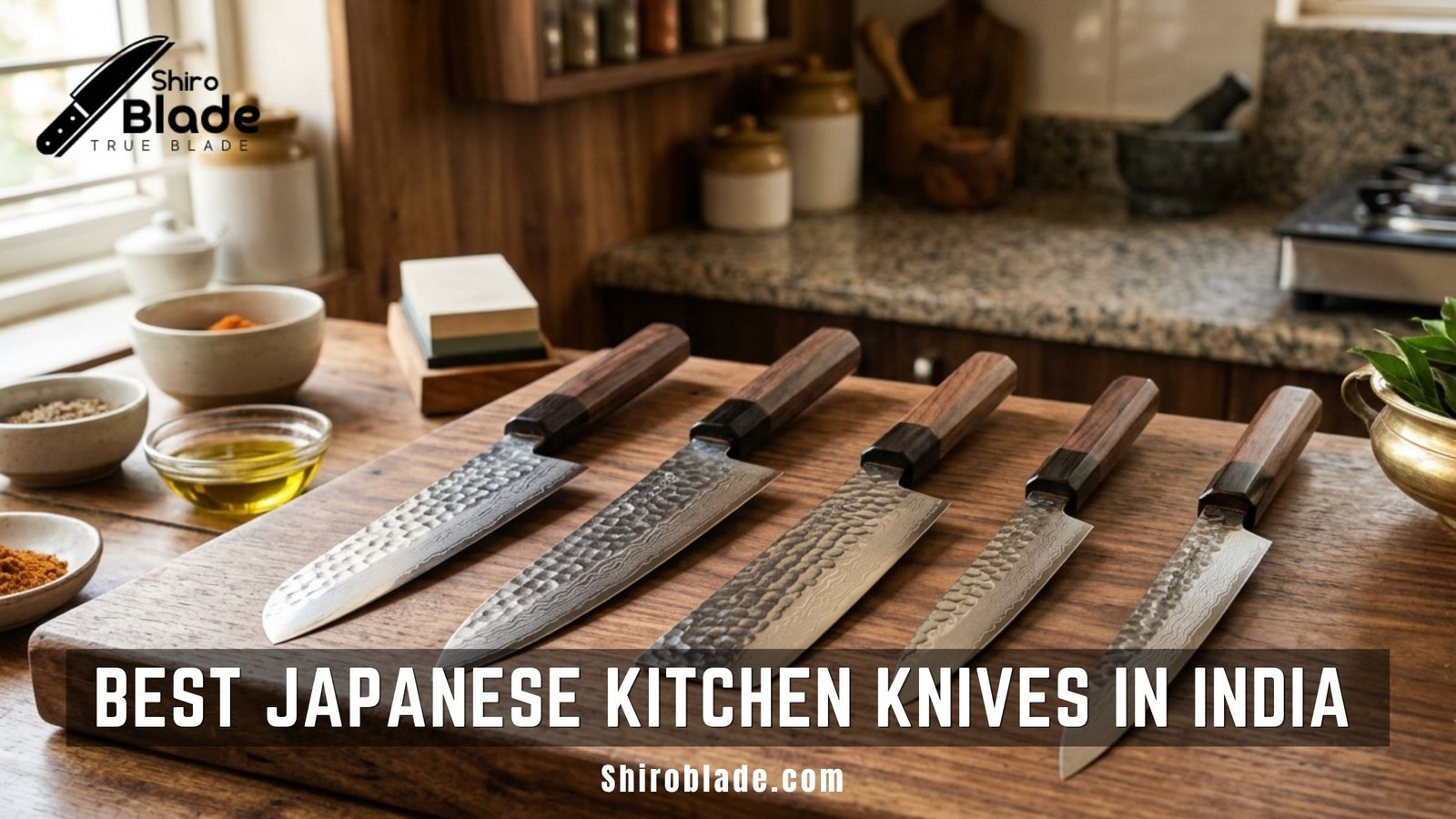
We compared 6 Japanese kitchen knives sold on Amazon.in on core steel, hardness, blade shape, handle and care, so you pick the right blade for Indian cooking, not just the prettiest one.
The best Japanese kitchen knife for you depends on what you cut most. A santoku handles onions, tomatoes and bhindi. A petty knife takes care of garlic, ginger and green chillies. A yanagiba (a long, single-bevel sashimi knife) slices fish like salmon, seer and pomfret in one clean pull.
This list covers six Japanese-made knives from Shun, Yoshihiro, Kai and Seki Magoroku: three santokus, one petty and two sashimi knives. Each pick has the specs from the brand or Amazon listing, honest limits and who should skip it. All of them are hard, thin blades, so none of them belong on chicken bones or frozen meat.
Disclosure: Shiroblade earns a small commission when you buy through our Amazon links, at no extra cost to you. Read our disclosure.
On This Page
Short Answer: Best Japanese Kitchen Knife in India
The best Japanese kitchen knife for most Indian home cooks is the Shun Premier 7-Inch Santoku (8.8/10). It has a VG-MAX core at 60–61 HRC, 68 layers of Damascus cladding, a 16° edge and a hammered finish that stops onion and potato slices sticking to the blade.
- Best compact santoku: Shun Classic 5.5-Inch Santoku, VG-MAX core and a light 142 g build (8.5/10)
- Best utility knife: Yoshihiro 46-Layer VG-10 Petty, 150 mm (8.4/10)
- Best traditional santoku: Yoshihiro NSW 46-Layer Santoku with rosewood handle and magnolia saya (8.3/10)
- Best for sashimi and fish: Kai Seki Magoroku Ginju ST 240 mm Yanagiba (8.0/10)
- Sturdiest sashimi knife: Seki Magoroku Kinju ST 240 mm (7.9/10)
Our Top Picks: Best Japanese Knives for Indian Kitchens

Yoshihiro 46-Layer Petty 150 mm
VG-10 at 60 HRC for garlic, ginger and fruit.
Quick Comparison: 6 Best Japanese Kitchen Knives
| Knife | Score | Type | Core Steel | HRC | Blade | Handle | Best For |
|---|---|---|---|---|---|---|---|
| Shun Premier 7-Inch | 8.8 | Santoku | VG-MAX | 60–61 | 178 mm | Walnut Pakkawood | Daily vegetable prep |
| Yoshihiro 46-Layer Petty | 8.4 | Petty (utility) | VG-10 | 60 | 150 mm | Octagonal Ambrosia wood | Garlic, ginger, fruit |
| Kai Ginju ST Sashimi | 8.0 | Yanagiba | Mo-V stainless | Not listed | 240 mm | Natural wood | Light fish slicing |
| Shun Classic 5.5-Inch | 8.5 | Santoku | VG-MAX | 60–61 | 140 mm | Ebony Pakkawood, D-shape | Small hands, quick prep |
| Seki Kinju ST Sashimi | 7.9 | Yanagiba | Mo-V stainless | 58 | 240 mm | Laminated wood | Large fish, wet sinks |
| Yoshihiro NSW Santoku | 8.3 | Santoku | VG-10 | 60 | 180 mm | D-shaped rosewood | Push-cutting vegetables |
HRC is the Rockwell hardness scale. Higher numbers hold an edge longer but chip more easily.
How We Rated These Japanese Knives
Each knife is scored out of 10 on five weighted criteria. Steel and edge carry the most weight, because that is what you pay for in a Japanese knife. Scores are based on the published specs, construction and design, compared against knives of the same type.
Edge & Steel
Core steel, HRC, edge angle.
Build & Finish
Cladding, grind, fit.
Handle & Balance
Grip when wet, weight, control.
Care & Rust
Rust resistance, upkeep.
Value
Price against similar knives.
Santoku vs Petty vs Yanagiba: Which Japanese Knife Do You Need?
Japanese kitchens use a different knife for each job. The six knives here fall into three shapes, and picking the right shape matters more than picking the brand.
- Santoku (Shun Premier, Shun Classic, Yoshihiro NSW): a flat-edged all-rounder for chopping, slicing and dicing. It works with an up-and-down push cut, which suits onions, tomatoes, cabbage and coriander. If you buy only one Japanese knife, buy a santoku.
- Petty (Yoshihiro 150 mm): a small utility knife that sits between a paring knife and a chef knife. Use it to peel ginger, slice garlic, deseed chillies and cut fruit. Our guide on paring knife uses shows where a small blade earns its place.
- Yanagiba (Kai Ginju ST, Seki Kinju ST): a long, narrow slicer sharpened on one side only. You draw it through fish in one long pull, so the flesh is not torn. It is a specialist knife, not a vegetable knife.
Single Bevel vs Double Bevel
The santoku and petty knives here are double bevel (sharpened on both sides), so they work for left and right-handed cooks. The two yanagiba knives are single bevel and made for right-handed use. For other shapes, from nakiri to deba, see our guide to Japanese kitchen knife types.
Detailed Reviews: 6 Best Japanese Kitchen Knives in India
The knives below are listed in our recommended order. Each review has the specs from the brand or Amazon listing, pros, cons and a score. Prices change often on imported knives, so check the latest price on Amazon before you buy.
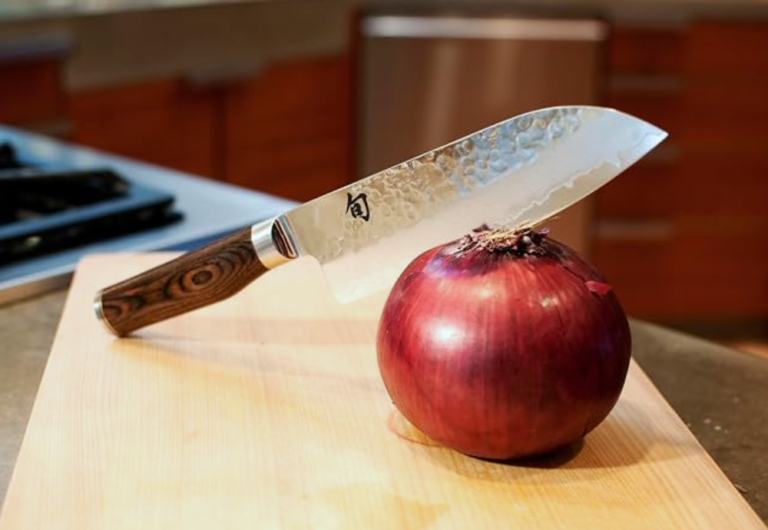
1. Shun Premier 7-Inch Santoku Knife
VG-MAX core, 68-layer Damascus and a hammered finish for everyday chopping.
| Brand | Shun (Kai Group) |
|---|---|
| Blade Type | Santoku |
| Core Steel | VG-MAX |
| Hardness | 60–61 HRC |
| Cladding | 68 layers of Damascus stainless (34 per side) |
| Blade Length | 7 in (178 mm) |
| Edge Angle | 16° per side, double bevel |
| Finish | Hammered (tsuchime) |
| Handle | Walnut-finish contoured Pakkawood, embossed end cap |
| Construction | Forged |
| Weight | 212 g |
| Origin | Seki City, Japan |
The Shun Premier is the knife we point most people to when they ask for one good Japanese knife. VG-MAX is Shun’s own steel: it adds extra carbon, chromium, cobalt and vanadium to VG-10, so it takes a fine edge and holds it longer between sharpenings.
Why It Works: The hammered tsuchime finish leaves small dimples on the blade. They break the suction that makes onion, potato and cucumber slices cling, so you spend less time wiping the blade. The edge is flat enough for push-cutting onions and tomatoes for a masala base, with a slight belly curve so you can also rock through coriander and mint. At 212 g it feels light and agile in the hand.
Check Before You Buy: At 60–61 HRC the edge is hard and thin. It will chip if you hit chicken bones, frozen fish or coconut shell, so keep a heavier knife for those jobs. Our list of the best Damascus knives in India compares it with other layered blades.
Limits: It is one of the costliest knives here. The Amazon listing marks it dishwasher safe, but hand washing and drying straight away keeps the edge and handle in better shape.
Rating Breakdown:
| Edge & Steel | 9.2 |
|---|---|
| Build & Finish | 8.8 |
| Handle & Balance | 9.0 |
| Care & Rust | 8.5 |
| Value | 8.0 |
Pros
- VG-MAX core holds a fine edge for months
- Hammered finish stops food sticking
- 68-layer stainless cladding resists rust
- Comfortable contoured Pakkawood handle
Cons
- Premium price
- Chips on bone, frozen food and coconut shell
- Hand wash advised, despite the dishwasher-safe listing
Verdict: The best all-round Japanese knife for daily vegetable prep if your budget allows it.
2. Yoshihiro 46 Layers VG-10 Hammered Damascus Petty Utility Knife (6 Inch)
A 150 mm VG-10 utility knife for garlic, ginger, chillies and fruit.
| Brand | Yoshihiro |
|---|---|
| Blade Type | Petty (utility knife) |
| Core Steel | VG-10 stainless |
| Hardness | 60 HRC |
| Cladding | 46-layer hammered Damascus |
| Blade Length | 6 in (150 mm) |
| Edge | Double bevel |
| Handle | Octagonal Ambrosia wood, Pakkawood bolster (Wa style) |
| Tang | Partial |
| Weight | 63.5 g |
| Dishwasher Safe | No |
| Origin | Japan |
A petty knife is the one you reach for when the santoku feels too big. This Yoshihiro uses a VG-10 core at 60 HRC wrapped in 46 layers of hammered Damascus, in a short 150 mm blade.
Why It Works: The narrow tip handles small jobs that make a santoku clumsy: peeling and julienning ginger, slicing garlic thin for a tadka, deseeding green chillies and cutting mango or papaya. The whole knife weighs just 63.5 g, and the octagonal Wa handle (Japanese-style handle) is light, so the balance sits forward, near the blade.
Check Before You Buy: VG-10 at 60 HRC is hard enough to chip if you twist it in a pumpkin or use it to pry open a coconut. Use it for slicing, not levering.
Limits: The Ambrosia wood handle needs a little mineral oil now and then and must not sit wet. A partial tang (the steel does not run the full handle length) is normal for Wa handles, but it feels different from a Western knife.
Rating Breakdown:
| Edge & Steel | 8.8 |
|---|---|
| Build & Finish | 8.6 |
| Handle & Balance | 8.4 |
| Care & Rust | 7.8 |
| Value | 8.0 |
Pros
- VG-10 core takes a very fine edge
- Small blade gives control for garlic, ginger and fruit
- Light octagonal handle suits both hands
- Hammered finish helps slices release
Cons
- Wood handle needs oiling
- Not for prying or hard squash
- Too short for big vegetables
Verdict: Pick this as a second knife next to a santoku or chef knife for all the small, precise work.
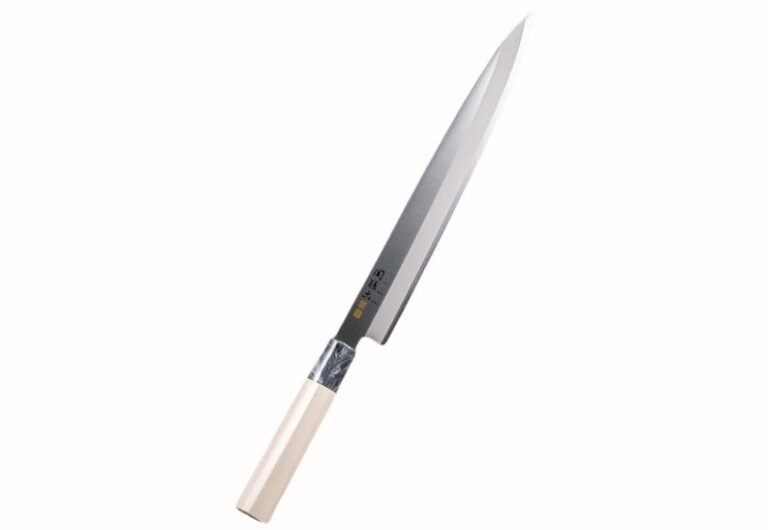
3. Kai Seki Magoroku Ginju ST Sashimi Knife 240 mm (AK-5068)
A light, single-bevel yanagiba in molybdenum-vanadium stainless steel for slicing fish.
| Brand | Kai (Seki Magoroku) |
|---|---|
| Model | AK-5068 |
| Blade Type | Yanagiba (sashimi knife) |
| Blade Steel | Molybdenum-vanadium stainless |
| Blade Length | 240 mm |
| Overall Size | 37 x 3.4 x 1.9 cm |
| Edge | Single bevel (right-handed) |
| Handle | Natural wood, nylon bolster |
| Weight | 92 g (knife only) |
| Origin | Japan |
This is Kai’s entry into proper Japanese sashimi knives. On Amazon.in it is listed as the Kai Seika Sekigan Silver Life (AK-5068). In Japan the same line is sold as Seki Magoroku Ginju ST. The blade is a single layer of molybdenum-vanadium stainless steel, so it handles the salt and moisture of fish prep well.
Why It Works: A 240 mm blade lets you slice a salmon or tuna loin in one long pull from heel to tip, which keeps the cut face glossy instead of torn. At 92 g it is light, so long slicing sessions do not tire your wrist. It also cuts thin slices of cooked meat and fillets fish like seer and pomfret.
Check Before You Buy: It is single bevel and right-handed. The flat back needs a few strokes on a whetstone to stay flat, and a pull-through sharpener will ruin the edge geometry. Kai does not publish an HRC for this model.
Limits: Do not use it on fish heads or bones. That is a job for a deba or a heavy cleaver.
Rating Breakdown:
| Edge & Steel | 8.2 |
|---|---|
| Build & Finish | 7.8 |
| Handle & Balance | 7.8 |
| Care & Rust | 8.4 |
| Value | 7.8 |
Pros
- Long 240 mm blade for single-stroke slicing
- Very light at 92 g
- Mo-V stainless resists rust from fish and salt
- Made in Japan by Kai
Cons
- Right-handed only
- HRC not published
- Needs whetstone sharpening
Verdict: The best pick here if you cook a lot of fish and want clean, single-stroke slices.
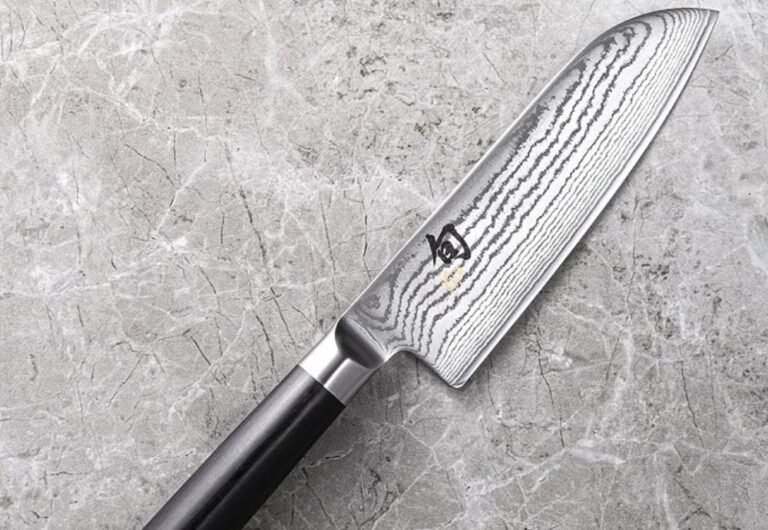
4. Shun Classic Santoku Knife, 5.5-Inch Blade
Shun’s classic Damascus santoku in a short, light blade for quick daily prep.
| Brand | Shun (Kai Group) |
|---|---|
| Model | DM0727 |
| Blade Type | Santoku |
| Core Steel | VG-MAX (current Shun spec) |
| Hardness | 60–61 HRC |
| Cladding | 68 layers per Shun (Amazon.in title lists 33 layers) |
| Blade Length | 5.5 in (140 mm) |
| Edge Angle | 16° per side |
| Handle | Ebony D-shaped Pakkawood, steel end cap |
| Weight | 142 g (5 oz) |
| Size | About 10.5 x 2 x 0.8 in |
| Warranty | Limited lifetime |
| Origin | Japan |
The Shun Classic is the line that made Shun famous: a Damascus-clad blade with a black D-shaped Pakkawood handle. This 5.5-inch santoku is the short, light version at just 142 g.
Why It Works: A 140 mm blade suits small kitchen counters and smaller cutting boards. It is quick for daily jobs like slicing onions, tomatoes and capsicum for one or two people, and it is easier to control than a 7-inch blade if you have smaller hands. The D-shaped handle has a ridge that sits against your fingers, so the knife does not roll in a wet hand.
Check Before You Buy: The Amazon.in title lists 33 layers, while Shun’s current spec is 68 layers around a VG-MAX core. Older Shun Classic stock used a VG-10 core with 33 layers. Both are hard Japanese stainless steels and cut much the same, but check the listing photos if the exact steel matters to you.
Limits: The standard D-handle suits right-handed cooks. The blade is too short for a whole cabbage or a large pumpkin. Like every Shun, keep it away from bones and frozen food.
Rating Breakdown:
| Edge & Steel | 9.0 |
|---|---|
| Build & Finish | 8.6 |
| Handle & Balance | 8.4 |
| Care & Rust | 8.4 |
| Value | 7.6 |
Pros
- Sharp 16° edge on a hard Japanese core
- Light 142 g build, easy to control
- D-shaped handle grips well when wet
- Fits small boards and counters
Cons
- Short blade for big vegetables
- Right-handed handle
- Amazon layer count differs from Shun spec
Verdict: Choose this if you want a Shun for quick daily prep and prefer a smaller, lighter blade.
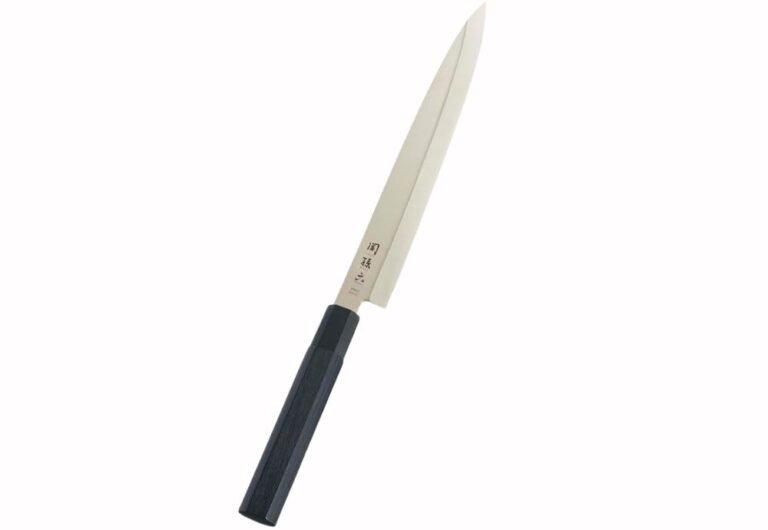
5. Seki Magoroku Kinju ST Sashimi Knife 240 mm (AK-1106)
A thicker, heavier single-bevel sashimi knife with a water-resistant laminated handle.
| Brand | Kai (Seki Magoroku) |
|---|---|
| Model | AK-1106 |
| Blade Type | Yanagiba (sashimi knife) |
| Blade Steel | High-carbon molybdenum-vanadium stainless |
| Hardness | 58 ±1 HRC |
| Blade Length | 240 mm |
| Overall Length | About 385 mm |
| Blade Thickness | 2.5 mm |
| Edge | Single bevel (right-handed) |
| Handle | Octagonal reinforced laminated wood, nylon bolster |
| Handle Length | 13.9 cm |
| Weight | 159 g |
| Origin | Japan |
Listed on Amazon.in as the Seki Gold Kotobuki ST, this is the Seki Magoroku Kinju ST yanagiba from Kai. It is built heavier than the Ginju ST: a 2.5 mm thick blade, an octagonal laminated wood handle and a weight of 159 g.
Why It Works: The extra weight carries the blade through the cut, so you press less while slicing large fish loins. The reinforced laminated handle is resin-bonded, so it copes with a wet fish-cleaning sink better than raw wood. At 58 HRC the stainless edge is tougher and less likely to chip than the harder VG-10 knives on this list.
Check Before You Buy: Like the Ginju, it is single bevel and right-handed, and it needs a whetstone to sharpen. Read how to use a knife sharpening stone before the first sharpening.
Limits: 58 HRC means more frequent touch-ups than a 60+ HRC knife. The listing says the heavy blade can cut through fish bones. Light bone work is fine, but use a deba or cleaver for fish heads and spines, because a thin yanagiba edge can still chip.
Rating Breakdown:
| Edge & Steel | 7.8 |
|---|---|
| Build & Finish | 7.6 |
| Handle & Balance | 8.0 |
| Care & Rust | 8.6 |
| Value | 7.8 |
Pros
- Tough 58 HRC stainless, less chipping
- Water-resistant laminated handle
- Heavier blade glides through large fish
- Made in Japan
Cons
- Needs sharpening more often
- Right-handed only
- Heavier than the Ginju ST for long sessions
Verdict: Pick this over the Ginju ST if you want a sturdier sashimi knife with a handle that copes with a wet sink.
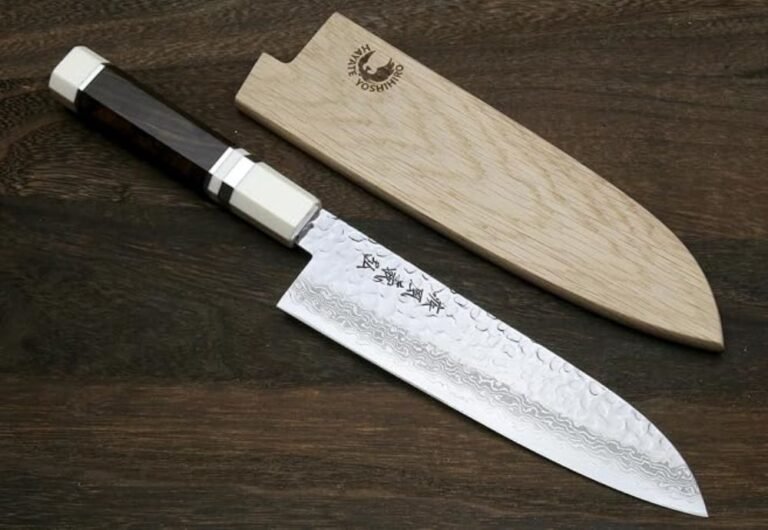
6. Yoshihiro NSW 46 Layers Hammered Damascus Santoku Knife 7 Inch with Magnolia Saya
A VG-10 santoku with a handcrafted D-shaped rosewood handle and a magnolia saya cover.
| Brand | Yoshihiro |
|---|---|
| Series | NSW |
| Blade Type | Santoku |
| Core Steel | VG-10 stainless |
| Hardness | 60 HRC |
| Cladding | 46-layer hammered Damascus |
| Blade Length | 7 in (180 mm) |
| Edge | Double bevel |
| Handle | Handcrafted D-shaped rosewood, shitan bolster |
| Construction | 3-layer: VG-10 core with hammered outer steel |
| Extras | Natural magnolia wood saya (sheath) |
| Weight | 127 g |
| Origin | Japan |
This is the traditional take on the santoku. Yoshihiro pairs a VG-10 core at 60 HRC with 46 layers of hammered Damascus, then fits a handcrafted D-shaped rosewood handle with a shitan bolster and a magnolia wood saya (sheath). The whole knife weighs only 127 g.
Why It Works: The wooden Japanese handle is lighter than a Western handle, so the weight sits in the blade. That forward balance helps when you push-cut dense vegetables like yam, raw banana and carrots. The saya protects the edge in a crowded drawer and between uses.
Check Before You Buy: Rosewood and magnolia are natural woods. Wipe the handle dry, oil it now and then, and let the saya air out if it gets damp. To tell real layered Damascus from a printed pattern, see our guide to real vs fake Damascus.
Limits: No dishwasher, no soaking and no bones. The D-shaped Japanese handle feels different if you are used to a Western knife.
Rating Breakdown:
| Edge & Steel | 8.8 |
|---|---|
| Build & Finish | 8.6 |
| Handle & Balance | 8.2 |
| Care & Rust | 7.6 |
| Value | 7.8 |
Pros
- VG-10 core with 46-layer hammered cladding
- Forward balance for push-cutting
- Light 127 g build with a secure D-shaped grip
- Magnolia saya protects the edge
Cons
- Natural wood handle and saya need care
- Hand wash and dry at once
- Japanese grip takes getting used to
Verdict: Pick this for traditional Japanese push-cut chopping and a knife that comes with its own sheath.
Buying Guide: How to Choose a Japanese Kitchen Knife
1. Core Steel and Hardness
Japanese knives are graded by their core steel. VG-10 and VG-MAX are hard stainless steels at around 60–61 HRC that keep a fine edge for a long time. Molybdenum-vanadium stainless, used in the Kai and Seki knives here, is a little softer, tougher and easier to sharpen. Our guide to types of Damascus steel explains how the core and cladding work together.
2. Blade Shape for Your Cooking
For mostly vegetables, buy a santoku of 140 to 180 mm. Add a petty for small work. Buy a yanagiba only if you slice raw or cooked fish often.
3. Single or Double Bevel
Double-bevel knives (santoku, petty) suit any cook. Single-bevel yanagiba knives are made for one hand, and the two here are right-handed.
4. Handle Style
Wa handles (octagonal Japanese handles) are light and give forward balance. D-shaped and Western-style handles fill the hand and feel familiar. Pakkawood and laminated wood resist moisture better than raw wood in humid kitchens.
5. Where It Is Made
All six knives here are made in Japan. Be careful with knives sold as Japanese for ₹1,000 to ₹3,000: many are made elsewhere with a printed Damascus pattern. Our guide on why Japanese knives are so expensive explains the price gap, including import duties.
6. What You Will Cut
Hard Japanese steel is made for slicing, not chopping through bone. If you cook a lot of chicken or mutton with bone, keep a heavier German-style knife or cleaver for that and save the Japanese knife for vegetables and fish.
How to Care for and Sharpen a Japanese Knife
Washing and Drying
Hand wash with mild soap right after use, especially after lemon, tamarind, onion or fish. Dry it fully with a cloth. Never put a Japanese knife in a dishwasher or leave it soaking in the sink.
Cutting Board
Use a wooden or soft plastic board. Steel plates, granite tops and glass boards dull and chip hard edges fast. See our picks for the best wooden chopping boards.
Sharpening and Honing
Use a whetstone: around 1000 grit to sharpen and 3000 to 6000 grit to polish. Never use a pull-through sharpener on a single-bevel knife. Light honing keeps the edge straight between sharpenings. Misen has a clear explainer on honing vs sharpening.
Rust and Stains
Stainless steel resists rust, but salt, acid and water left on the blade can still spot it. If you see orange spots, follow our guide on how to remove rust from knives.
Storage
Keep the knife in its saya, a knife block or on a magnetic strip. Loose in a drawer, the tip and edge will chip.
FAQs
The Shun Premier 7-Inch Santoku is our top pick at 8.8/10. It has a VG-MAX core at 60–61 HRC, 68 layers of Damascus cladding and a hammered finish that helps food release from the blade.
For most vegetable prep, yes. A santoku has a flatter edge for push-cutting onions, tomatoes and greens. A chef knife (gyuto) rocks better through herbs and suits larger cuts. Many home cooks use a santoku daily and keep a heavier knife for meat with bone.
No. VG-10 and VG-MAX blades at 60–61 HRC are hard and thin, and they chip on bone. Use a cleaver or a softer German-style knife for chicken and mutton with bone.
A yanagiba is a long, single-bevel slicing knife for raw fish and sashimi. It cuts in one long pull, so the fish is not torn. It also slices cooked meat thinly. It is not meant for vegetables or bones.
If you cook daily and look after your knives, yes. A hard Japanese core stays sharp much longer than the soft steel in most budget knives. If you often cut bones or use steel plates as boards, a German-style knife is the safer buy.
With home use, sharpen on a whetstone every two to four months and hone lightly between sharpenings. Softer Mo-V knives like the Seki Kinju ST need touch-ups a little more often than VG-10 or VG-MAX knives.
Yes. All six knives on this list are made in Japan. Shun and Seki Magoroku knives are made by the Kai Group in Seki City, and Yoshihiro knives are handcrafted by Japanese makers.
Our Verdict: Which Japanese Knife Should You Buy?
Pick the shape first, then the steel. For most Indian kitchens, a santoku is the right first Japanese knife, a petty is the best second knife, and a yanagiba only makes sense if you slice fish often.
Shun Premier 7-Inch Santoku (8.8/10)
VG-MAX core with a hammered, non-stick finish.
Yoshihiro 46-Layer Petty (8.4/10)
VG-10 utility knife for garlic, ginger and fruit.
Kai Seki Magoroku Ginju ST 240 mm (8.0/10)
Single bevel, 92 g.
Shun Classic 5.5-Inch Santoku (8.5/10)
142 g with a D-shaped handle.
Seki Magoroku Kinju ST 240 mm (7.9/10)
58 HRC with a laminated handle.
Yoshihiro NSW Santoku (8.3/10)
Rosewood D-handle and magnolia saya.
A hard Japanese edge needs the right sharpener to stay that way. See our best knife sharpeners in India for whetstones that suit VG-10 and VG-MAX steel. Want to compare more brands first? Read our best kitchen knife brands in India guide.
Sources
- Amazon.in product listings for each knife (model, blade length and materials as listed).
- Shun (Kai USA) product pages for the Premier 7-inch Santoku and the Classic 5.5-inch Santoku.
- eChefKnife (Yoshihiro) pages for the 46-layer petty.
- Kai Seki Magoroku Ginju ST and Kinju ST yanagiba specifications from Japanese retailer listings.
- Misen, honing vs sharpening explainer.
Related guides: Japanese Kitchen Knife Types | Best Damascus Knives in India | How to Sharpen a Knife | Best Knife Stands in India

Indian knife collector with a deep respect for Japanese knife making. What began as an interest in Damascus patterns grew into a focused study of Japanese knives from Sakai and Seki. Through Shiroblade, I share simple guides on buying, using, and caring for knives, helping readers understand real craftsmanship beyond looks.

Pingback: 10 Best Kitchen Knife Brands in India (2026) - ShiroBlade