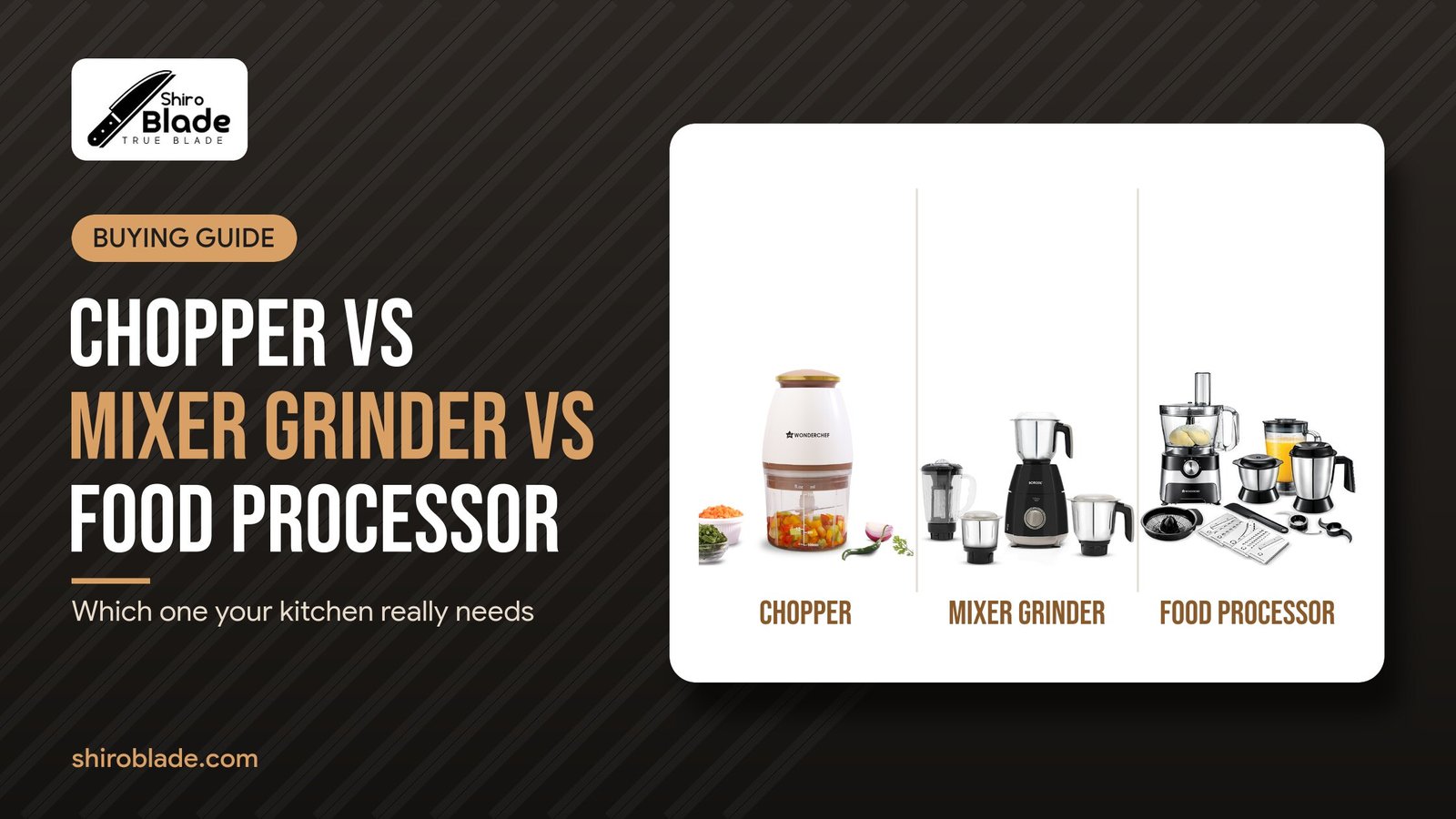
Short answer: a mixer grinder grinds (batter, masala paste, spice powder, chutney), an electric chopper chops (onion, garlic, ginger, chillies, coriander) and a food processor does both plus slicing, grating and kneading atta. Most Indian homes already own a mixer grinder, so the next buy is usually a chopper. A food processor makes sense only if you cook for 5 or more people or slice and grate in bulk every week.
All three machines spin blades, which is why they get mixed up. But the speed, the shape of the jar and the blades decide what comes out: a paste, an even chop or neat slices. This guide compares them job by job, the way you actually use them while cooking dal, sabzi, chutney and rotis.
Affiliate disclosure: Some links on this page are Amazon.in affiliate links. If you buy through them, I may earn a small commission at no extra cost to you. Read the disclosure.
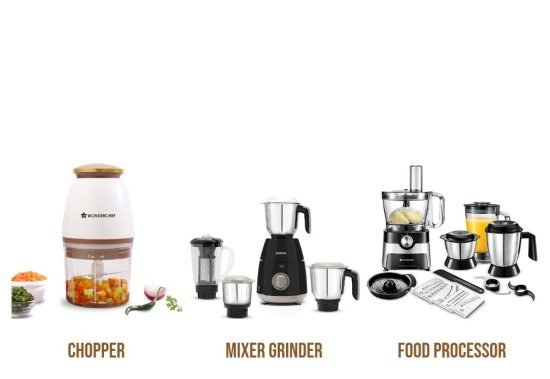
What Each Machine Is Built to Do
Electric Chopper: Fast Chopping in Short Pulses
An electric chopper has a motor on top of a short bowl and two or three S-shaped blades stacked on a central pin. It runs at a lower speed than a mixer and works in short pulses, so it cuts food into small pieces instead of turning it into paste. Most models are 200 to 400 W with a 0.5 to 2 litre bowl.
It is built for the daily masala base: 2 onions for a curry, a handful of garlic and ginger, green chillies, coriander, boneless chicken for keema. You pulse 4 to 6 times, check and stop. See our step-by-step guide to using an electric chopper for timings.
Mixer Grinder: High-Speed Grinding with Jars
A mixer grinder is the tall base with 3 or 4 stainless steel jars that almost every Indian kitchen has. Its motor is 500 to 1,000 W and spins at about 18,000 to 22,000 RPM. That speed is perfect for grinding but too fast for chopping. Run onions in it for 3 seconds and you get a wet paste.
The jars split the work: a large wet jar for idli and dosa batter, a dry jar for spice powders, a small chutney jar for coconut chutney and ginger-garlic paste, and often a juicer jar for lassi and fruit juice.
Food Processor: One Base, Many Attachments
A food processor has a wide, flat bowl and a set of attachments: a chopping blade, slicing and shredding discs, often a julienne disc, a dough kneader and a citrus juicer. In India, most models are sold as a combo with 2 or 3 mixer jars, so one motor of 600 to 1,000 W does grinding as well.
Its real strength is the slicing and grating discs. A food processor can slice a kilo of onions for biryani, grate carrots for gajar ka halwa or shred cabbage for coleslaw in a few minutes, and knead dough for 6 to 8 rotis. That is work a chopper or a mixer grinder cannot do.
Quick Comparison Table
| Feature | Electric Chopper | Mixer Grinder | Food Processor |
|---|---|---|---|
|
Main job |
Chop and mince |
Grind, blend, paste |
Chop, slice, grate, knead, grind |
|
Motor power |
200 to 400 W |
500 to 1,000 W |
600 to 1,000 W |
|
Speed |
Low, pulse based |
Very high (18,000+ RPM) |
Variable, 2 to 3 speeds plus pulse |
|
Bowl or jars |
One 0.5 to 2 L bowl |
3 to 4 steel jars |
Wide bowl plus discs and jars |
|
Onion result |
Even small pieces |
Paste if you are not careful |
Chopped, sliced or grated |
|
Counter space |
Small, fits a shelf |
Medium |
Large, needs a fixed spot |
|
Cleaning |
Bowl, lid and blade |
One jar at a time |
Many parts after each use |
|
Typical price |
₹1,000 to ₹3,500 |
₹2,500 to ₹8,000 |
₹5,000 to ₹15,000 |

Which Machine Does Which Kitchen Job? (15 Indian Cooking Tasks)
This is the table to check before you buy. It lists everyday Indian cooking jobs and which of the three machines does each one best. ‘Best’ marks the top choice for each job.
| Kitchen job | Chopper | Mixer Grinder | Food Processor |
|---|---|---|---|
|
Finely chopped onion for curry base |
Best |
No (turns to paste) |
Good |
|
Onion paste for gravy |
Fair |
Best |
Good |
|
Ginger-garlic paste |
Fair (coarse) |
Best |
Good |
|
Chopped garlic and green chillies |
Best |
No |
Good |
|
Coriander and mint chopping |
Best |
No |
Good |
|
Green chutney |
Fair |
Best |
Good |
|
Idli and dosa batter |
No |
Best |
Fair (combo jars only) |
|
Dry spice powder (garam masala) |
No |
Best |
Good (combo jars only) |
|
Boneless keema |
Best |
No |
Good |
|
Thin onion slices for biryani |
No |
No |
Best |
|
Grated carrot for halwa |
No |
No |
Best |
|
Shredded cabbage |
No |
No |
Best |
|
Atta dough for rotis |
No |
No |
Best |
|
Lassi, milkshake, juice |
No |
Best |
Good |
|
Crushed peanuts or cashews |
Best |
Fair (pulse only) |
Good |
The pattern is clear. The mixer grinder owns everything that must become smooth. The chopper owns everything that must stay in pieces. The food processor covers both and adds slicing, grating and kneading, at a higher price and with more parts to wash.
Chopper vs Mixer Grinder
This is the comparison most Indian buyers face, because the mixer grinder is already on the counter. The question is whether a chopper adds anything. It does, for one reason: texture.
A mixer grinder’s blades are designed to pull food down into a vortex and grind it fine. That is what you want for batter and paste, and exactly what you do not want for a bhuna masala where onions should brown as small pieces. With a chopper, the low speed and pulse button let you stop at a coarse, medium or fine chop.
| Point | Chopper | Mixer Grinder |
|---|---|---|
|
Daily onion, garlic, chilli prep |
Yes, in 10 to 20 seconds |
Only as paste |
|
Batter and spice powders |
No |
Yes |
|
Washing after a small job |
1 bowl and 1 blade |
1 jar, but blade is fixed |
|
Noise |
Lower |
Loud |
|
Run time per batch |
Under 1 minute in pulses |
2 to 3 minutes for batter |
Verdict: keep the mixer grinder for grinding and add a chopper for chopping. They do not replace each other. If you are choosing a chopper, our list of the best electric vegetable choppers in India compares 8 models on motor, blades and bowl size.
Chopper vs Food Processor
A food processor can chop, so is a chopper a waste of money once you own one? For most small families, the opposite is true. People who buy a big food processor often stop using it for daily work because setting it up and washing the bowl, lid, pusher and blade takes longer than chopping 2 onions by hand.
A chopper is small enough to stay on the counter. You add the onion, pulse, scrape and wash 3 parts. For a 2 to 4 person home cooking once or twice a day, that convenience is why it gets used every day.
| Point | Chopper | Food Processor |
|---|---|---|
|
Best batch size |
1 to 4 onions |
500 g to 1 kg |
|
Slicing, grating, julienne |
No |
Yes, with discs |
|
Kneading dough |
No |
Yes |
|
Set-up time |
Seconds |
1 to 2 minutes |
|
Parts to wash |
3 |
5 to 8 |
|
Price |
Lower |
2 to 4 times higher |
Verdict: choose a food processor if you cook for 5 or more people, run a tiffin service or slice and grate in bulk. Otherwise a chopper does the daily jobs faster. Our guide to the types of vegetable choppers also covers manual, pull-cord and cordless options.

Mixer Grinder vs Food Processor
If you are replacing an old mixer grinder, a food processor combo can look like the smarter buy, since it includes mixer jars. It can be, if you will use the discs. Here is the trade-off.
| Point | Mixer Grinder | Food Processor Combo |
|---|---|---|
|
Batter and masala grinding |
Excellent |
Good (same type of jars) |
|
Slicing and grating |
No |
Yes |
|
Atta kneading |
No |
Yes |
|
Storage space |
Base plus 3 to 4 jars |
Base, bowl, discs and jars |
|
Learning curve |
None |
Need to learn which disc goes where |
|
Price for a good model |
₹3,000 to ₹6,000 |
₹7,000 to ₹15,000 |
Verdict: if you only grind, a good 750 W mixer grinder is enough and costs less. Pick a food processor combo when slicing onions, grating vegetables and kneading dough take up a big part of your cooking time.
Which One Should You Buy First?
| Your kitchen | Buy first | Why |
|---|---|---|
|
Single person or couple |
Electric chopper |
Small batches, quick wash, low price |
|
Family of 3 to 4 with a mixer grinder |
Electric chopper |
Fills the chopping gap the mixer cannot |
|
Family of 5 or more |
Food processor combo |
Bulk slicing, grating and kneading save real time |
|
South Indian home that grinds batter often |
Mixer grinder (or wet grinder) |
Grinding is the daily job |
|
Small kitchen or rented flat |
Chopper plus mixer grinder |
Both fit on a shelf, a processor needs counter space |
|
Home tiffin or catering |
Food processor |
Volume matters more than wash time |
Budget check: a chopper plus a mixer grinder usually costs less than one good food processor combo and covers 12 of the 15 jobs in the table above. For a full breakdown of what each chopper budget gets you, see our electric chopper price guide.
What None of These Machines Can Replace
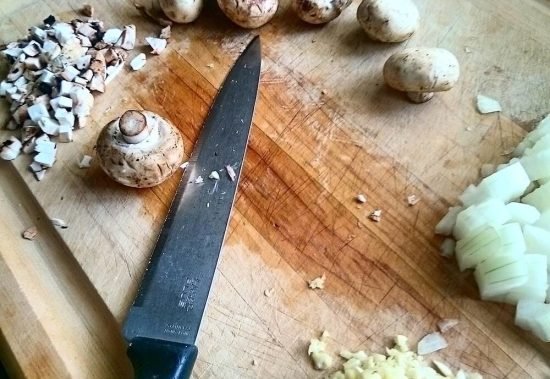
Even a food processor cannot give you everything. Thin onion rings for garnish, even bhindi rounds, cubed paneer, diced potatoes for aloo jeera and julienne ginger for dal all need a sharp knife and a steady board. Machines also bruise herbs if you over-pulse them.
A good chef knife handles these jobs in a minute and needs no washing beyond one rinse. Our guides to the types of vegetable cutting and types of kitchen knives show which cuts and blades to use. If you want a knife that stays sharp for years, start with our best Japanese kitchen knives in India.
Buying Tips for All Three
- Check the ISI mark. All three are household electrical appliances. Look for the ISI mark and the model number on the box.
- Pick a copper-wound motor. It runs cooler and lasts longer, which matters for mixer grinders that run 2 to 3 minutes per batter batch.
- Look at working capacity, not total. A 1 litre chopper bowl often chops only about 500 g at a time.
- Count the parts. More attachments means more washing. Only pay for discs you will use every week.
- Check the warranty and service network. Brands with service centres in your city save you shipping a heavy base back to the seller.
- Do not overrun the motor. Choppers are rated for short runs of about 30 to 60 seconds. Pulse, rest and repeat.
FAQs
Can a mixer grinder be used as a chopper?
Only roughly. On the pulse setting with the small chutney jar you can coarsely chop nuts or garlic, but onions and tomatoes release water and turn into paste within 2 to 3 seconds. For an even chop, a chopper or a food processor works much better.
Is a food processor better than a mixer grinder?
It is more versatile, not better at grinding. A food processor slices, grates and kneads, but a dedicated mixer grinder is simpler and usually cheaper for batter and masala. Many Indian food processors include mixer jars, so you get both in one base.
Can a chopper grind masala or make batter?
No. A chopper runs slower and its bowl is not built for wet grinding or dry spice powders. Use a mixer grinder for idli batter, dosa batter and garam masala.
Which is best for a small family?
An electric chopper alongside the mixer grinder you already have. It handles the daily onion, garlic and chilli prep, is quick to wash and fits on a shelf.
Can a food processor make chapati dough?
Yes. Most food processors come with a plastic dough blade or kneader that mixes atta and water into dough in about 1 to 2 minutes. Add water slowly and stop once the dough forms a ball.
Do I need all three machines?
Most homes do not. A mixer grinder plus a chopper covers almost every daily job. Add a food processor only if you slice, grate or knead in large quantities.

Indian knife collector with a deep respect for Japanese knife making. What began as an interest in Damascus patterns grew into a focused study of Japanese knives from Sakai and Seki. Through Shiroblade, I share simple guides on buying, using, and caring for knives, helping readers understand real craftsmanship beyond looks.