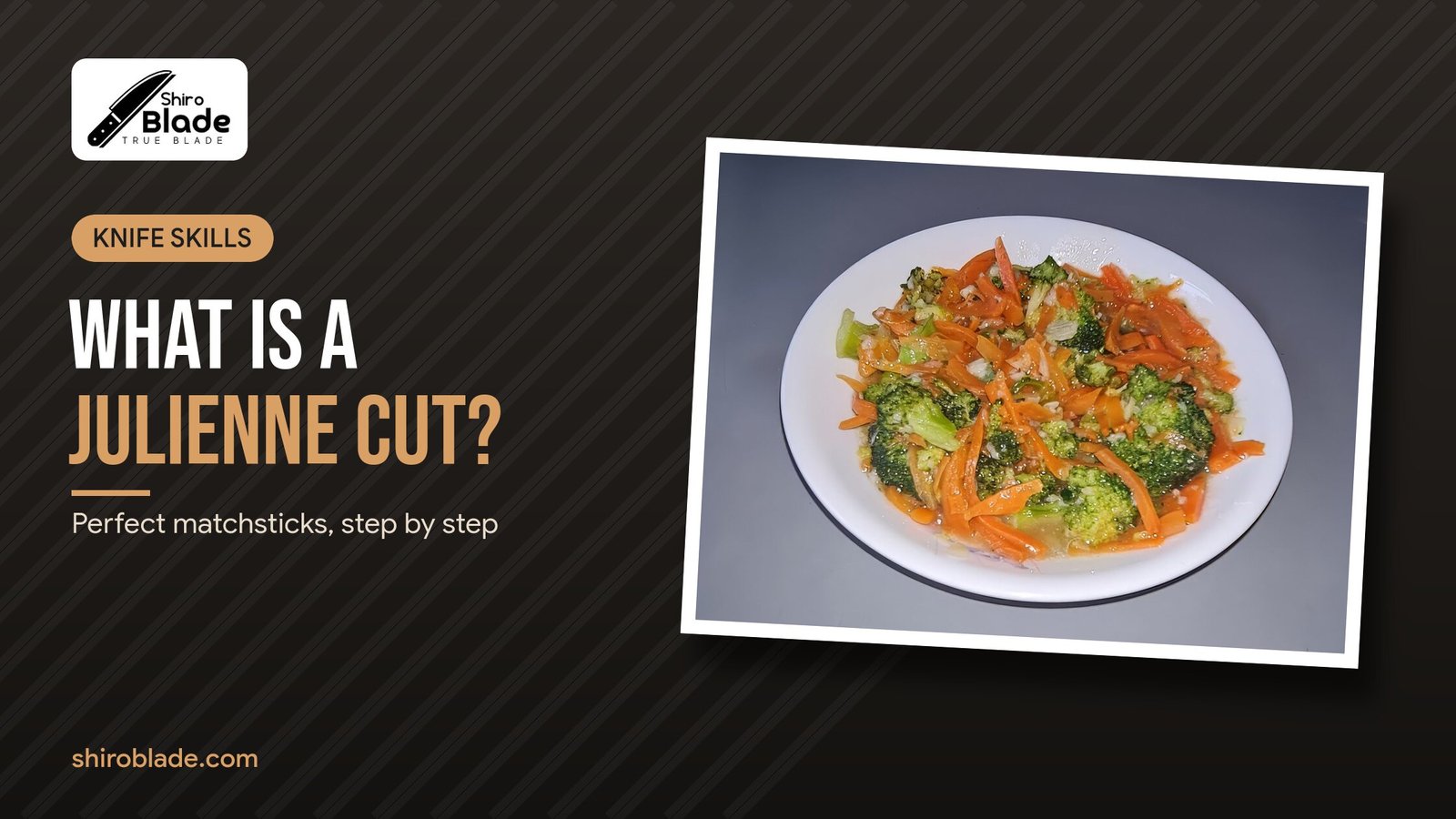
Short answer: a julienne cut (say “joo-lee-en”) turns vegetables into thin, even matchsticks about 3 mm x 3 mm x 5 cm (1/8 x 1/8 x 2 inches). You square off the vegetable, slice it into 3 mm planks, stack the planks and cut them into 3 mm sticks. Cut those sticks crosswise and you get a brunoise, a 3 mm dice.
Julienne is the cut behind crunchy veg Hakka noodles, spring roll filling, carrot and cabbage salads and the thin ginger strips on top of dal makhani. It cooks in seconds, looks neat and holds a dressing well. This guide covers the exact sizes, a step-by-step method, the knife to use, and when a peeler or mandoline does the job faster.
Affiliate disclosure: Some links on this page are Amazon.in affiliate links. If you buy through them, I may earn a small commission at no extra cost to you. Read the disclosure.

Julienne Cut Size and Its Cousins
Professional kitchens use fixed sizes so every piece cooks at the same speed. Julienne sits in a family of stick and dice cuts that all start the same way. Here are the standard sizes.
| Cut | Size (metric) | Size (inches) | Common use |
|---|---|---|---|
|
Fine julienne |
1.5 mm x 1.5 mm x 5 cm |
1/16 x 1/16 x 2 |
Garnish, ginger strips, clear soups |
|
Julienne (allumette) |
3 mm x 3 mm x 5 cm |
1/8 x 1/8 x 2 |
Stir fries, noodles, salads |
|
Batonnet |
6 mm x 6 mm x 6 cm |
1/4 x 1/4 x 2.5 |
Carrot sticks, vegetable platters, pickles |
|
Baton (French fry) |
1 cm x 1 cm x 6 cm |
1/2 x 1/2 x 2.5 |
Fries, aloo sticks |
|
Brunoise |
3 mm cubes |
1/8 cube |
Fine dice for chutneys, raita, fried rice |
|
Fine brunoise |
1.5 mm cubes |
1/16 cube |
Garnish, sauces |
Allumette (French for “matchstick”) is mostly the same size as julienne. Chefs usually say allumette for potatoes and julienne for other vegetables. For the full family of cuts, including dice, chiffonade and roll cut, see our guide to the types of vegetable cutting.
How to Julienne Vegetables in 5 Steps
We will use a carrot, the most common vegetable to julienne. The same steps work for cucumber, radish, beetroot, capsicum and potato.
Step 1: Peel and Cut into 5 cm Lengths
Peel the carrot, trim both ends and cut it into 5 cm (2 inch) pieces. Shorter pieces are easier to control and give you sticks of the right length.
Step 2: Square Off One Side
Slice a thin strip off one side so the piece lies flat on the board. A round vegetable that rolls is the main cause of cut fingers. Square off all four sides if you want perfectly even sticks, and save the trimmings for soup, sambar or stock.
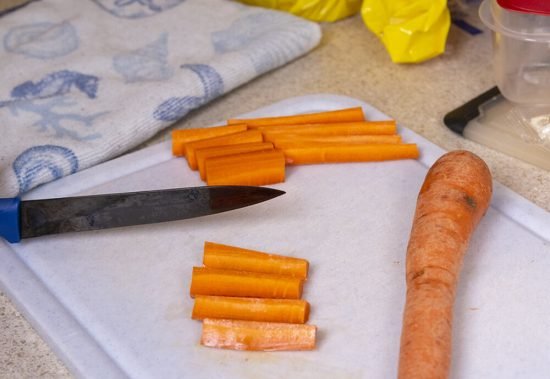
Step 3: Slice into 3 mm Planks
Lay the piece on its flat side and slice down into planks about 3 mm thick. Use the claw grip: fingertips tucked in, knuckles touching the flat of the blade, so the knife guides along your knuckles and never meets your fingertips.
Step 4: Stack the Planks
Stack 2 or 3 planks on top of each other. Do not stack too high, or the pile slides and the sticks come out uneven.
Step 5: Cut into 3 mm Sticks
Slice the stack lengthwise into 3 mm strips. You now have julienne. For a brunoise, gather the sticks into a bundle, turn them 90 degrees and cut across at 3 mm to make tiny cubes.
Best Knife for a Julienne Cut
A julienne cut depends on a sharp, thin blade more than anything else. A dull knife crushes the carrot instead of slicing it, and the planks crack or come out wedge-shaped.
| Knife | Good for | Why |
|---|---|---|
|
Chef knife (20 cm) |
Carrot, potato, beetroot, radish |
Long edge slices whole planks in one stroke |
|
Santoku or nakiri |
Cucumber, capsicum, zucchini |
Flat edge cuts straight down for clean sticks |
|
Paring knife |
Ginger, garlic, small pieces |
Easy control on small, fibrous pieces |
Japanese knives are especially good here because their thin, hard blades hold a very fine edge. See our list of the best Japanese kitchen knives in India, or our guide to kitchen knife types if you are still choosing. Before you start, give the edge a few strokes on a honing rod or sharpener. Our guide on how to sharpen a knife at home shows four easy methods.
Julienne Peeler, Mandoline or Food Processor?
A knife gives the cleanest julienne, but tools are faster when you are cutting a lot. Here is how they compare.
| Tool | Speed | Result | Watch out for |
|---|---|---|---|
|
Chef knife |
Slow at first, fast with practice |
Cleanest, any thickness |
Needs a sharp edge and practice |
|
Julienne peeler |
Fast for 1 to 2 carrots |
Thin, slightly curly strips |
Works on firm vegetables only |
|
Mandoline with julienne blade |
Very fast |
Even, straight sticks |
Sharp blade, always use the hand guard |
|
Food processor julienne disc |
Fastest for 1 kg or more |
Good, sometimes uneven ends |
Large set-up and wash time |
|
Electric chopper |
Not possible |
Small chopped pieces, not sticks |
Choppers cannot julienne |
An electric chopper is great for onion, garlic and chilli prep but cannot make sticks, because its S-blades spin through the food. If you are deciding between machines, our guide to chopper vs mixer grinder vs food processor explains which one slices and which one only chops. For daily chopping, our list of the best electric vegetable choppers in India compares 8 models.

Vegetables That Julienne Well (and Tips for Each)
| Vegetable | Tip |
|---|---|
|
Carrot |
Pick thick, straight carrots. Thin ends make short, uneven sticks. |
|
Cucumber |
Cut away the watery seed core first so the sticks stay crisp. |
|
Capsicum (bell pepper) |
Cut off the top and bottom, open it flat, remove the ribs and slice skin side down. |
|
Ginger |
Peel with a spoon, slice into thin coins, stack and cut into fine strips. |
|
Beetroot |
Wear gloves or cut on a plastic board to avoid stains. |
|
Radish (mooli) |
Works like carrot. Soak the sticks in cold water for extra crunch. |
|
Potato |
Rinse the sticks in cold water to remove starch before frying. |
|
Raw mango |
Peel, cut the flesh off the seed, then slice and stack. Good for quick pickles. |
|
Spring onion |
Cut 5 cm lengths and slice lengthwise for a curly garnish in ice water. |
Indian Dishes That Use a Julienne Cut
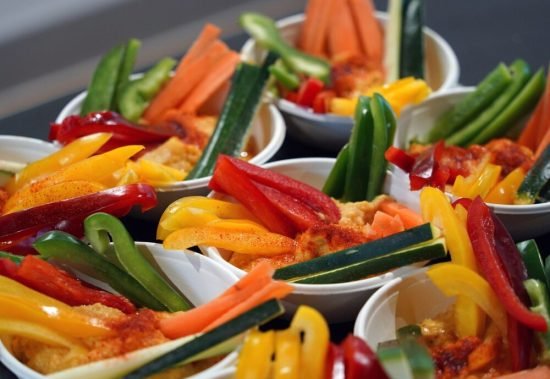
- Veg Hakka noodles and fried rice: julienne carrot, cabbage, capsicum and spring onion cook in 1 to 2 minutes on high heat and stay crunchy.
- Spring rolls: thin vegetable strips roll tightly and cook through inside the wrapper.
- Dal makhani, butter chicken and kadhi: fine ginger julienne is a classic garnish on top.
- Carrot and cucumber salads: julienne holds lemon, salt and chaat masala better than chunks.
- Chilli paneer and manchurian: julienne ginger and green chilli in the sauce base.
- Instant pickles: carrot, ginger and raw mango sticks pickle quickly in lemon juice, salt and mustard.
- Raita: julienne cucumber gives a cleaner bite than grated cucumber and releases less water.
Common Julienne Mistakes
- Skipping the flat side. A rolling vegetable leads to uneven sticks and cut fingers.
- Using a dull knife. The carrot cracks instead of slicing, and the planks come out thick at one end.
- Stacking too many planks. Keep it to 2 or 3 so the stack stays still.
- Mixed thickness. Thick and thin sticks cook at different speeds, so some go soft while others stay raw.
- Cutting too far ahead. Julienne cucumber and potato lose crunch or turn brown. Keep potatoes in cold water and cut cucumber just before serving.
Julienne vs Brunoise vs Chiffonade
| Cut | Shape | How you get it | Best for |
|---|---|---|---|
|
Julienne |
Thin matchsticks |
Planks cut into 3 mm sticks |
Stir fries, salads, garnish |
|
Brunoise |
Tiny 3 mm cubes |
Julienne cut crosswise |
Fried rice, chutney, raita, sauces |
|
Chiffonade |
Thin ribbons |
Leaves rolled tight and sliced thin |
Basil, mint, palak, curry leaves |
Once you can cut a clean julienne, brunoise is one extra step. Both need a steady board. A wooden or plastic board is kinder to the edge than steel or glass. See our guide to the types of cutting boards.
FAQs
What is the size of a julienne cut?
A standard julienne is about 3 mm x 3 mm x 5 cm (1/8 x 1/8 x 2 inches). A fine julienne is half that thickness, about 1.5 mm, and is used mostly for garnish.
What is the difference between julienne and brunoise?
Julienne is a thin stick. Brunoise is a tiny 3 mm cube made by cutting julienne sticks crosswise. You always julienne first, then brunoise.
Is allumette the same as julienne?
They are almost the same size, about 3 mm thick. Allumette is the name usually used for potatoes, as in matchstick fries, and julienne for other vegetables.
Can I julienne vegetables in an electric chopper?
No. A chopper’s spinning S-blades cut food into small irregular pieces, not sticks. Use a knife, a julienne peeler, a mandoline or a food processor with a julienne disc.
Which knife is best for julienne?
A sharp 20 cm chef knife for most vegetables, a santoku or nakiri for soft ones like cucumber and capsicum, and a paring knife for ginger and garlic.
Why is it called julienne?
The word is French. It appears in French cookbooks from the early 1700s for soups made with thin strips of vegetables, and the name stayed with the cut.

Indian knife collector with a deep respect for Japanese knife making. What began as an interest in Damascus patterns grew into a focused study of Japanese knives from Sakai and Seki. Through Shiroblade, I share simple guides on buying, using, and caring for knives, helping readers understand real craftsmanship beyond looks.