
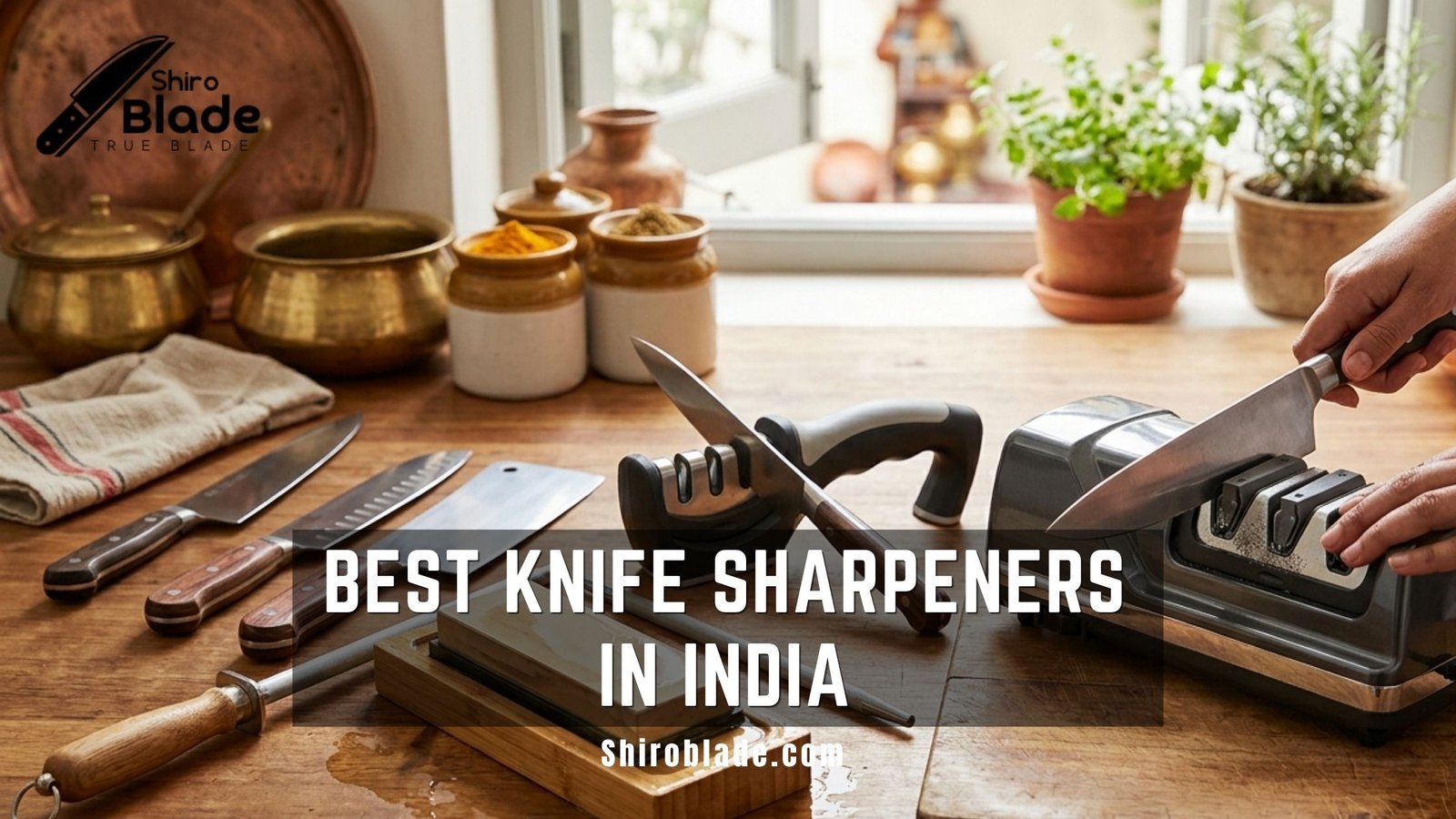
We compared 7 knife sharpeners across 5 types, from pull-through to whetstone, so you can pick the right one for the knives in your kitchen.
The best knife sharpener for you depends less on the brand and more on your knives. A ₹300 knife in soft stainless steel and a Japanese Damascus gyuto need very different sharpeners. The wrong one can wear away a cheap blade or chip an expensive one.
This guide covers every common type on Amazon India: pull-through, sharpening stone, rolling, electric, and a rod for serrated knives. Each pick has real specs, honest limits and a note on whether it suits cheap knives.
Disclosure: Shiroblade earns a small commission when you buy through our Amazon links, at no extra cost to you. Read our disclosure.
Short Answer: Best Knife Sharpener in India
The best knife sharpener for most Indian kitchens is the Kai Seki Magoroku Diamond & Ceramic Sharpener (8.6/10). Its three stages (diamond, ceramic wheel, fine ceramic) take a dull knife to a finished edge, and it copes with harder steel than basic pull-through sharpeners.
- Best for serrated knives: Victorinox Portable Knife Sharpener (8.3/10)
- Best sharpening stone: Oblivion Dual-Grit Silicon Carbide Stone (8.2/10)
- Best guided angle: Turbid Rolling Knife Sharpener (7.9/10)
- Fastest: Narcissus 2-Stage Electric Sharpener (7.6/10)
- Best for cheap ₹300–500 knives: AccuSharp ACCU-001C (7.5/10), with light pulls
- Pocket serrated rod: Siyurongg Diamond Rod (6.9/10)
Our Top Picks

Kai Seki Magoroku Diamond & Ceramic Sharpener
Three stages from coarse to fine, handles harder steel.
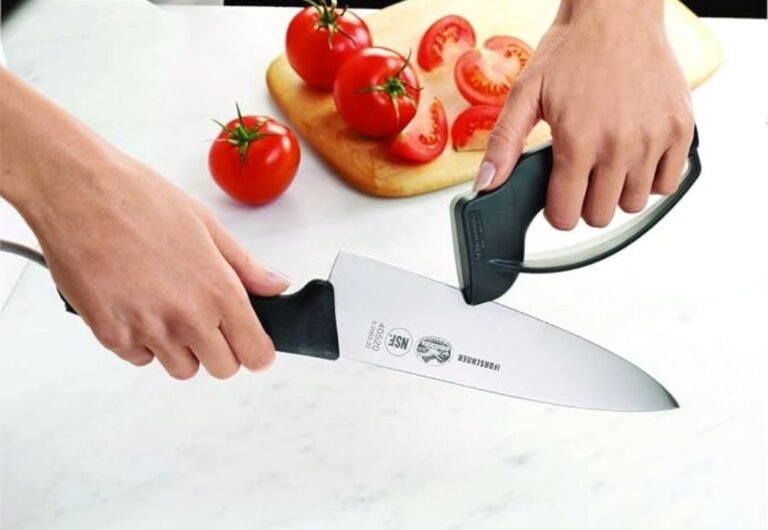
Victorinox Portable Knife Sharpener
Ceramic blades, suits serrated and straight edges.
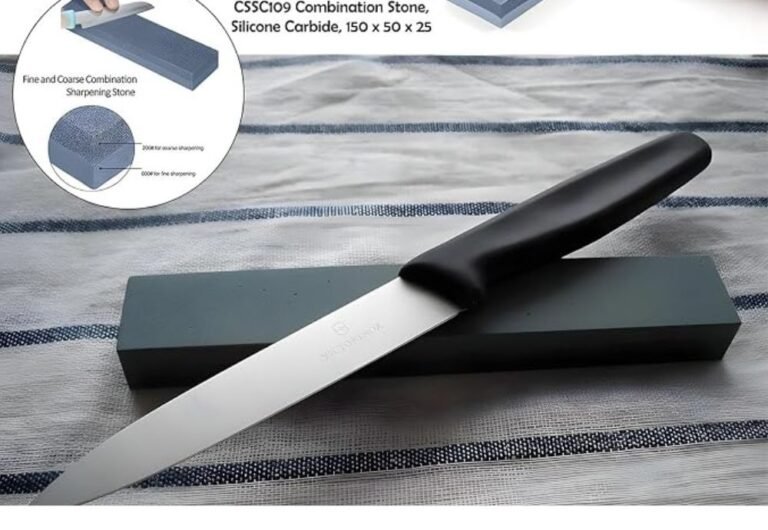
Oblivion Dual-Grit Sharpening Stone
Double-sided stone with base and angle guide.
Quick Comparison: Best Knife Sharpeners in India
| Sharpener | Score | Type | Abrasive | Best For | Cheap Knives? |
|---|---|---|---|---|---|
| Kai Magoroku | 8.6 | Pull-through, 3 slots | Diamond and ceramic | Dull or harder-steel kitchen knives | Yes, light pulls |
| Victorinox | 8.3 | Hand-held, ceramic blades | Reversible ceramic blades | Serrated knives and quick touch-ups | Yes |
| AccuSharp | 7.5 | Pull-through, hand-held | Tungsten carbide | Soft, budget knives and quick fixes | Yes, best fit |
| Oblivion Stone | 8.2 | Double-sided whetstone | Silicon carbide | Best edge, Japanese and Damascus knives | Yes, with practice |
| Turbid Rolling | 7.9 | Rolling, magnetic angle block | Diamond and ceramic discs | Beginners who want a guided angle | Yes, if the blade is magnetic |
| Narcissus Electric | 7.6 | Electric, 2 stages | Ceramic, coarse and fine | Many knives, fast, plus scissors | Yes, go easy |
| Siyurongg Rod | 6.9 | Pocket diamond rod | Diamond rod | Serrated and pocket knives | Serrated blades only |
How We Rated These Knife Sharpeners
Each sharpener is scored out of 10 using five weighted criteria. Edge result carries the most weight, because that is the whole job. Knife friendliness matters too, since an aggressive sharpener can wear a thin blade or chip a hard one.
Edge Result
How sharp and clean the finished edge is.
Ease & Safety
Skill needed, grip and finger safety.
Knife Friendliness
How much steel it removes, soft or hard knives.
Build & Durability
Materials, weight and listing quality.
Versatility
Knife types, serrated and scissors covered.
How a Knife Sharpener Works
A knife edge is where two faces meet in a very fine line. With use, that line rolls over and wears down, and the knife feels dull. There are two ways to fix it.
- Sharpening grinds a thin layer of steel off both faces to create a new, clean edge. Coarse abrasives (diamond, carbide, silicon carbide) remove steel fast. Fine ones (ceramic, fine stone) polish it.
- Honing only straightens an edge that has bent over. It removes almost no steel, so a honing rod keeps a sharp knife sharp but cannot rescue a dull one.
Angle and Grit
The angle is how steeply each face meets the abrasive. Western and most Indian kitchen knives are made for about 20° per side, and Japanese-style knives often use about 15°. A smaller angle cuts better but is more delicate. Grit is the coarseness: a low number is coarse and repairs damage, a high number is fine and polishes. Most Amazon listings give only the words coarse or fine, so we flag it for each pick.
The 5 Types in This Guide
- Pull-through: You pull the knife through fixed slots. Easy, fast, and the angle is set for you.
- Sharpening stone: You hold the angle by hand. Best edge and control, with a learning curve.
- Rolling sharpener: A magnetic block holds the knife at a set angle while you roll a disc along the edge.
- Electric: A motor spins the abrasive. Fastest, and removes the most steel.
- Diamond rod: A small rod that fits the scallops of serrated blades.
Detailed Reviews: 7 Best Knife Sharpeners in India
The sharpeners below are grouped by type. Each has specs, pros, cons and a score, plus a clear answer on whether it suits cheap knives. Need a new knife first? See our best kitchen knives under ₹1000 and under ₹2000.
1. Kai Seki Magoroku Diamond & Ceramic Knife Sharpener
A 3-slot diamond and ceramic sharpener that goes from coarse to fine in one tool.
| Brand | KAI (Kai Corporation, Japan) |
|---|---|
| Model | AP-0308 |
| Type | Manual pull-through, 3 stages |
| Abrasive | Diamond stones, ceramic wheel, ceramic steels |
| Grit (as listed) | Coarse; grain 270, 150 and 1000 by stage |
| Dimensions | 14 x 6 x 4.5 cm |
| Weight | 95.2 g |
| Best For | Dull kitchen knives, harder stainless steel |
Kai is a Japanese knife maker, and this is the sharpener to buy if your knives are a step above basic, such as a good German or Japanese knife set. It has three slots that run from coarse to fine. Slot 1 holds two small diamond stones (listed as grain 270) to restore a dull edge. Slot 2 is a ceramic wheel (listed as grain 150), and slot 3 has two ceramic steels (listed as grain 1000) that polish the edge. The listing grain numbers are not on one clear scale, so just follow the slot order: 1, 2, 3.
Why It Works: Diamond cuts hard steel that basic carbide slots struggle with, so it handles harder stainless knives as well as soft ones. The three stages leave the edge finished instead of rough.
Handling: The casing doubles as a handle, which keeps it steady while you pull. It is small (14 x 6 x 4.5 cm, 95 g) and comes with a clear cover for storage.
Limits: It is still a fixed-angle pull-through, so it is not the tool for a thin, very hard Japanese knife such as a VG10 gyuto. Use a stone for those.
Rating Breakdown:
| Edge Result | 9.0 |
|---|---|
| Ease & Safety | 8.5 |
| Knife Friendliness | 8.5 |
| Build & Durability | 8.5 |
| Versatility | 8.0 |
Pros
- Three stages from coarse to fine
- Diamond handles harder steel
- Casing works as a handle
- Compact, with a clear storage cover
Cons
- Fixed angle, so not for thin Japanese knives
- Listing grain numbers are not on one clear scale
- No serrated knife support listed
Verdict: The best all-round sharpener here for Indian kitchens. Buy it if your knives are a step above basic, and use a stone for your best Japanese blades.
2. Victorinox Portable Knife Sharpener with Reversible Blades
A small Swiss ceramic sharpener that the listing says suits serrated and straight edges.
| Brand | Victorinox (Swiss made) |
|---|---|
| Type | Portable hand-held sharpener |
| Abrasive | Reversible ceramic blades, refittable |
| Material (as listed) | Stainless steel |
| Grit (as listed) | Coarse |
| Dimensions | 13.5 x 6.5 x 3.6 cm |
| Weight | 70 g |
| Handle | Synthetic, with finger grooves |
| Best For | Serrated and wavy-edge knives, Swiss Army knives, straight kitchen knives |
The Victorinox is a small hand-held sharpener with reversible ceramic blades. When one side wears out, the blades can be refitted, so it keeps working for years. It is Swiss made, and the listing says it suits serrated and wavy-edge knives as well as Swiss Army knives.
Why It Works: Ceramic is gentler than carbide, so it takes off less steel and suits a knife you want to keep. The synthetic handle has finger grooves, which helps you hold it firmly while you sharpen.
Limits: The listing grades it as coarse and gives no grit number, so think of it as a quick touch-up tool rather than a polisher. A chipped edge needs a stone.
Best Use: Keep it in a drawer for the bread knife, the tomato knife or a paring knife that has gone dull.
Rating Breakdown:
| Edge Result | 7.8 |
|---|---|
| Ease & Safety | 8.5 |
| Knife Friendliness | 8.5 |
| Build & Durability | 8.5 |
| Versatility | 8.5 |
Pros
- Listing says it suits serrated and wavy edges
- Reversible ceramic blades can be refitted
- Finger-groove handle for a firm grip
- Small enough for a drawer or a bag
Cons
- No grit number given
- Quick touch-up tool, not a polisher
- A badly chipped edge needs a stone
Verdict: A reliable small sharpener for serrated knives and quick touch-ups. Gentler on your steel than carbide.
3. AccuSharp ACCU-001C World Fastest Sharpener
A palm-sized tungsten carbide sharpener for quick edges on soft, budget knives.

| Brand | AccuSharp |
|---|---|
| Model | ACCU-001C |
| Type | Hand-held pull-through |
| Abrasive | Tungsten carbide |
| Grit (as listed) | Coarse |
| Dimensions | 12.7 x 12.7 x 12.7 cm |
| Weight | 45.4 g |
| Colour | White |
| Best For | Cheap stainless knives, fast touch-ups |
AccuSharp is a palm-sized tungsten carbide sharpener. At 45 g it is the lightest here, and it works as a quick pull-through: a few passes bring back a bite on a dull blade. Carbide cuts fast, which suits the soft stainless steel in budget knives.
Why It Works for Cheap Knives: Knives in the ₹300–500 range are usually soft stainless steel (around 54–56 HRC, a hardness rating) that dulls fast and sharpens easily. A coarse carbide slot restores one in seconds. See our best kitchen knife sets under ₹500 and under ₹300 for the kind of knives it suits.
Go Easy: Carbide removes steel quickly. Use 3 to 5 light pulls, then check the edge. Over-sharpening wears a thin cheap blade away and leaves a rough edge. Do not use it on a Damascus or Japanese knife.
Limits: The listing gives coarse grit only and does not mention serrated knives.
Rating Breakdown:
| Edge Result | 7.5 |
|---|---|
| Ease & Safety | 9.0 |
| Knife Friendliness | 6.5 |
| Build & Durability | 7.5 |
| Versatility | 7.0 |
Pros
- Lightest sharpener here at 45 g
- Very fast on dull, soft blades
- Simple to use, no skill needed
- Low-cost way to revive a budget knife
Cons
- Coarse grit only, so the edge is rough
- Removes steel fast, so go easy
- Not for Damascus or hard Japanese knives
Verdict: The best fit for ₹300–500 knives. Use 3 to 5 light pulls and stop, and keep it away from your good knives.
4. Oblivion Dual-Grit Silicon Carbide Sharpening Stone with Bamboo Base
A heavy double-sided whetstone with a bamboo base and an angle guide.
| Brand | Oblivion |
|---|---|
| Type | Double-sided sharpening stone |
| Abrasive | Silicon carbide (carborundum, corundum) |
| Grit (as listed) | Coarse and fine, numbers not given |
| Dimensions | 25 x 11 x 7 cm |
| Weight | 927 g |
| Includes | Bamboo base, sharpening guide, safety case |
| Best For | Kitchen knives, chisels and cutting tools |
This is the traditional option: a double-sided stone with a coarse side to repair a dull edge and a fine side to finish it. At 25 x 11 x 7 cm and 927 g it is the heaviest sharpener here, and that weight keeps it from sliding. The set includes a bamboo base, a sharpening guide to hold the angle, and a safety case.
Why Choose a Stone: A stone gives you control over the angle and the amount of steel you remove. Done well, it gives the sharpest, longest-lasting edge in this list, and it is the safest choice for Japanese and Damascus knives. See our best Damascus knives in India and Japanese kitchen knife types.
Learning Curve: You hold the angle by hand (about 20° for most Indian kitchen knives), so the first few sessions take patience. The included guide helps.
Limits: The listing gives no grit numbers, so you cannot tell exactly how coarse or fine each side is. Like most stones, it will wear into a dip over time, so flatten it now and then.
Rating Breakdown:
| Edge Result | 9.0 |
|---|---|
| Ease & Safety | 6.5 |
| Knife Friendliness | 8.5 |
| Build & Durability | 8.0 |
| Versatility | 8.5 |
Pros
- Coarse and fine sides in one stone
- Heavy at 927 g, so it stays put
- Bamboo base and angle guide included
- Control over angle and steel removal
Cons
- Takes practice to hold the angle
- Grit numbers not listed
- Like most stones, it will dish with use
Verdict: The best choice if you want the sharpest edge and own Japanese or Damascus knives. Plan for a short learning curve.
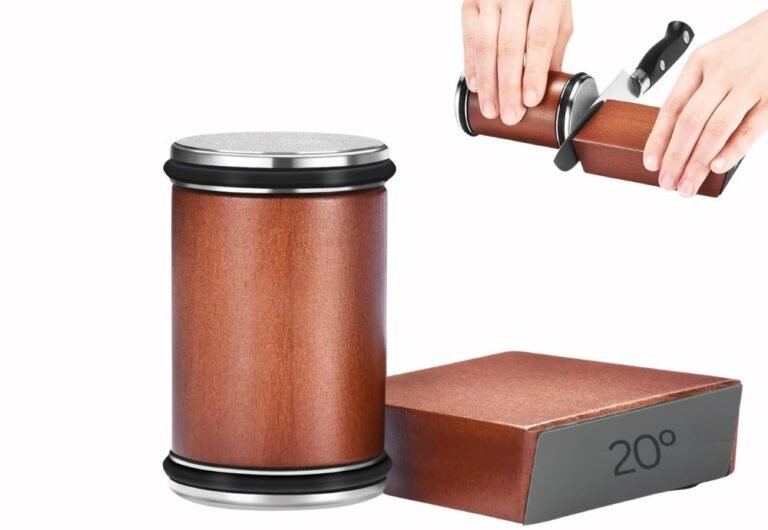
5. Turbid Rolling Knife Sharpener with 15° and 20° Magnetic Angles
A rolling sharpener that holds the knife on a magnetic block at a fixed angle.
| Brand | Turbid |
|---|---|
| Type | Rolling sharpener with magnetic holder |
| Abrasive | Diamond grinding disc, ceramic honing disc |
| Angles | 15° and 20° |
| Grit (as listed) | Very fine |
| Dimensions | 10 x 6 x 5.5 cm |
| Weight | 370 g |
| Magnets | N52 neodymium |
| Best For | Straight-edge kitchen, chef, santoku and pocket knives |
A rolling sharpener holds the knife on a magnetic wooden block at a fixed angle while you roll a disc along the edge. The Turbid offers two angles, 15° and 20°, so it covers Japanese-style knives and Western or Indian ones. It has a diamond grinding disc to reset the edge and a ceramic disc to refine it.
Why It Works: The magnets and fixed angle remove the guesswork, which is the hardest part of using a stone. Your fingers stay away from the edge, so it is also one of the safer options here.
Check Your Knife First: The block holds the blade with N52 neodymium magnets, so the blade must be magnetic. Many kitchen knives are, but some cheap 304 or 202 stainless blades are not. Test yours with a fridge magnet before you buy.
Limits: The listing says straight-edge knives only, so no serrated blades. Long or heavily curved blades can be harder to keep flat on a small block.
Rating Breakdown:
| Edge Result | 8.0 |
|---|---|
| Ease & Safety | 8.0 |
| Knife Friendliness | 8.5 |
| Build & Durability | 7.0 |
| Versatility | 7.5 |
Pros
- Fixed 15° and 20° angles, no guesswork
- Fingers stay away from the edge
- Diamond disc resets, ceramic disc refines
- Wooden magnetic block holds the knife steady
Cons
- Straight-edge knives only
- Needs a magnetic blade
- Rolling takes longer than a pull-through
Verdict: The easiest way to get a controlled, even edge without learning stone technique. Check your knife with a magnet first.
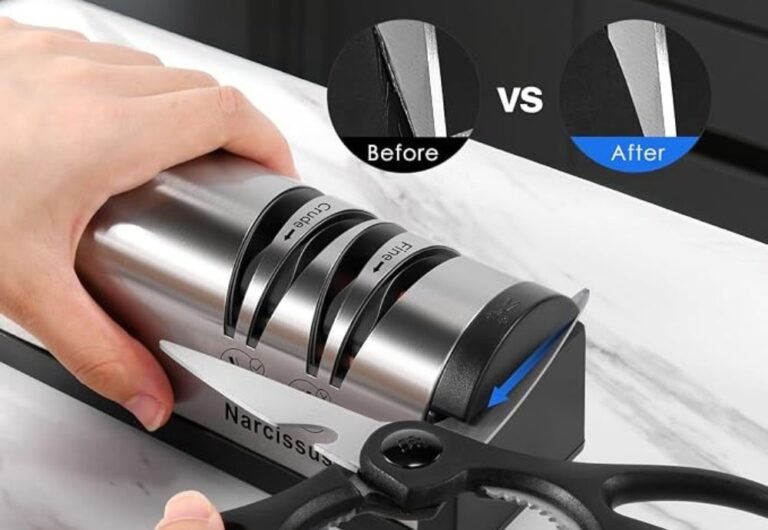
6. Narcissus 2-Stage Electric Knife Sharpener with Scissors Slot
A motorised two-stage sharpener with a side slot for scissors.
| Brand | Narcissus |
|---|---|
| Type | Electric, 2-stage (coarse and fine) |
| Motor | 30 W DC, 100–240 V |
| Extras | Scissors slot, magnetic metal dust box |
| Material (as listed) | Ceramic |
| Dimensions | 5.5 x 9 x 10 cm |
| Weight | 739 g |
| Best For | Chef, slicing and santoku knives, kitchen scissors |
The Narcissus is a motorised, two-stage sharpener: a coarse slot to grind a new edge, then a fine slot to polish. You pull the knife through each slot 2 to 5 times, as the listing says. A magnetic box collects the metal dust, and a side slot sharpens scissors. Compare scissors in our best kitchen scissors in India.
Why It Works: It is the fastest option here and needs the least skill. It suits a home with many dull knives and a few kitchen scissors. A 30 W DC motor and a 100–240 V rating mean it can run on Indian mains power, but check the plug type.
Go Easy: A motor removes steel quickly. Use it on everyday stainless knives, not on Damascus, VG10 or other hard Japanese knives. Stop as soon as the edge bites.
Angle: The listing does not state the sharpening angle, so assume a fixed factory angle that you cannot change. Check that it suits your knives.
Rating Breakdown:
| Edge Result | 7.5 |
|---|---|
| Ease & Safety | 9.0 |
| Knife Friendliness | 6.5 |
| Build & Durability | 7.0 |
| Versatility | 8.0 |
Pros
- Fastest option, needs no technique
- Coarse stage to sharpen, fine stage to polish
- Side slot for scissors
- Magnetic box collects metal dust
Cons
- Removes steel fast, so it can wear thin blades
- Not for hard Japanese or Damascus knives
- Sharpening angle not listed
Verdict: Good for a busy home with many dull everyday knives and a pair of scissors. Keep your best knives off it.
7. Siyurongg Pocket Serrated Knife Sharpener with Retractable Diamond Rod
A tiny retractable diamond rod for serrated and pocket knives.

| Brand | Siyurongg |
|---|---|
| Type | Pocket sharpening rod, retractable |
| Abrasive | Diamond rod |
| Material (as listed) | Alloy steel |
| Grit (as listed) | Fine |
| Dimensions | 12.5 x 1.1 x 1 cm |
| Weight | 32 g |
| Best For | Serrated knives, pocket knives, outdoor use |
This is a pocket-sized retractable diamond rod, 12.5 cm long and 32 g. Serrated knives are hard to sharpen because each scallop needs its own pass, and a rod is the right shape for that job. You sharpen the angled face of each scallop with the rod, one at a time, and leave the flat side alone.
Why Include It: Bread knives, tomato knives and some steak knives are serrated, and most sharpeners above are for straight edges only (the Victorinox listing is the exception). A diamond rod also copes with harder steel.
Limits: It is slow, since you work scallop by scallop. The listing says fine grit but gives no rod diameter or grit number, and the brand is little known, so treat it as a low-cost tool, not a long-term buy.
Rating Breakdown:
| Edge Result | 6.5 |
|---|---|
| Ease & Safety | 7.5 |
| Knife Friendliness | 8.0 |
| Build & Durability | 6.0 |
| Versatility | 6.5 |
Pros
- Fits into the scallops of serrated blades
- Only 32 g, fits a pocket
- Retractable, so the diamond rod stays covered
- Low-cost way to revive a bread knife
Cons
- Slow, as you sharpen scallop by scallop
- No rod diameter or grit number listed
- Little-known brand and a thin listing
Verdict: A cheap, specialised tool for serrated blades. Do not expect it to replace a main sharpener.
Buying Guide: How to Choose the Best Knife Sharpener
1. Which Type Suits You
- Pull-through: The easiest and cheapest. Best for beginners and everyday knives.
- Sharpening stone: The best edge and the most control, but you must learn the angle. Best for good knives.
- Rolling sharpener: A guided angle with no skill needed, but slower, and the blade must be magnetic.
- Electric: Fastest for many knives, but it removes the most steel.
- Diamond rod: A small tool for serrated and pocket knives.
2. Can Cheap ₹300–500 Knives Use These?
Yes. Cheap knives are made from soft stainless steel that sharpens easily, so almost any sharpener here will work. The risk is removing too much steel from a thin blade. Start with a pull-through such as the AccuSharp or Kai and use 3 to 5 light pulls. A ceramic sharpener such as the Victorinox is gentler still. Expect a cheap knife to go dull again in a few weeks, because soft steel does not hold an edge for long. Shopping for knives too? See our best kitchen knife sets under ₹500, under ₹300 and best kitchen knives under ₹1000.
3. Sharpening Good Knives: Japanese, Damascus and German
Hard steels such as VG10 and SG2 (around 60–63 HRC) hold an edge longer but chip if you grind them roughly. Use a stone or a guided rolling sharpener, not a coarse carbide slot or an electric machine. For mid-range knives, the Kai is a safe middle ground. Not sure what you own? Read how to choose a kitchen knife, types of kitchen knives and the best Damascus knives in India.
4. Sharpening Angle
Match the angle of the knife. Western and most Indian kitchen knives use about 20° per side, and Japanese-style knives often about 15°. Pull-through sharpeners fix the angle for you, which is why they are not ideal for 15° knives. The Turbid offers both 15° and 20°, and the Oblivion stone comes with an angle guide. If a listing does not state the angle, as with the Narcissus, assume a fixed factory angle you cannot change.
5. Grit: Coarse, Medium and Fine
On a stone, a low number (about 200 to 400) is coarse and repairs chips and very dull edges. Around 1000 is a general sharpening grit. 3000 and above is fine and polishes. Most listings here give only coarse or fine. Two- and three-stage sharpeners such as the Kai and Narcissus run from coarse to fine for you.
6. Sharpening vs Honing
Sharpening removes steel to make a new edge. Honing straightens an edge that has bent. A honing rod does not replace any sharpener in this list. For home cooks, a real sharpening every few months is usually enough, with a quick hone in between if you own a rod.
7. Serrated Knives
Most sharpeners here are for straight edges. The Victorinox listing says it suits serrated and wavy edges, and the Siyurongg rod is made for them. The Turbid listing says straight edges only, and the AccuSharp and Narcissus listings do not mention serrated knives. Check the listing before you try one on a bread knife.
8. Safety and Stability
Sharpen on a non-slip surface, keep fingers behind the blade, and wash the knife afterwards to remove metal dust. A heavy stone with a base (Oblivion) or a block that holds the knife (Turbid) is steadier than a small hand-held tool.
How to Care for Your Sharpener
- Pull-through: Brush out metal dust with a dry brush. Do not soak it.
- Stone: Rinse after use, let it dry fully, and flatten it when it starts to dip.
- Rolling and ceramic discs: Wipe with a damp cloth and keep them dry.
- Electric: Empty the dust box after each session.
How to Use Each Knife Sharpener
Pull-Through (Kai, Victorinox, AccuSharp)
Hold the sharpener steady on a non-slip surface. Place the heel of the blade in the slot and pull toward you, heel to tip, with light pressure. Repeat 3 to 5 times. Use the coarse stage first, then the fine stage if there is one. Wash and dry the knife.
Sharpening Stone (Oblivion)
Set the stone on the bamboo base on a damp cloth so it cannot slide. Start on the coarse side. Hold the knife at about 20° (use the guide) and push the edge across the stone as if slicing a thin layer off it. Do the same number of strokes on each side, then switch to the fine side to finish. Rinse the knife and the stone. Our step-by-step guide on how to use a knife sharpening stone covers the angle and burr check in more detail.
Rolling Sharpener (Turbid)
Check that the knife is magnetic. Choose 15° or 20°, rest the blade on the magnetic block, and roll the diamond disc along the edge from heel to tip. Finish with the ceramic disc, then wipe the blade.
Electric (Narcissus)
Pull the knife through the coarse slot 2 to 5 times, keeping the blade against the slot wall as the listing says, then do the same in the fine slot. Empty the dust box afterwards.
Diamond Rod (Siyurongg)
Match the rod to each scallop and work along the angled face with light strokes, one scallop at a time. Leave the flat side alone, then test on a tomato.
How to Test Sharpness
Hold a sheet of paper and slice down through it. A sharp knife cuts it cleanly without tearing. You can also slice a ripe tomato: it should cut without pressure.
FAQs
The Kai Seki Magoroku Diamond & Ceramic Sharpener is our top pick at 8.6/10. It has three stages from coarse to fine and handles harder steel than basic pull-through sharpeners. For the sharpest result and for Japanese knives, a sharpening stone such as the Oblivion is better.
Yes. Cheap knives use soft stainless steel that sharpens easily. Use a pull-through such as the AccuSharp or Kai with 3 to 5 light pulls, or a gentler ceramic sharpener such as the Victorinox. Avoid over-sharpening, because thin cheap blades wear away quickly.
A pull-through is easier and faster, and fine for everyday knives. A whetstone gives a sharper, longer-lasting edge and suits Japanese and Damascus knives, but it takes practice to hold the angle.
Not for hard Japanese or Damascus knives. A motor removes steel quickly, which can wear thin edges or chip hard steel. Electric sharpeners suit everyday stainless knives. Use a stone for your best blades.
For home cooking, a real sharpening every few months is usually enough, depending on how much you cook. Touch up earlier if tomatoes start to slip under the blade. Honing between sharpenings keeps the edge straight.
Yes, but with the right tool. The Victorinox listing says it suits serrated and wavy edges, and the Siyurongg diamond rod is made for them. Most other sharpeners here are for straight edges only, so check the listing first.
Sharpening grinds off steel to create a new edge. Honing straightens an edge that has bent over and removes almost no steel. A honing rod cannot fix a truly dull knife.
Only if it is made for scissors. Of the sharpeners here, the Narcissus electric model has a dedicated scissors slot. Other sharpeners are designed for knife blades, so do not use them on scissors.
Our Verdict
The best knife sharpener depends on your knives. Find yours below. If you own both cheap and good knives, the best pair is a quick pull-through for the cheap ones and a stone or guided sharpener for the good ones.
Kai Seki Magoroku Diamond & Ceramic Knife Sharpener (8.6/10)
Three stages, diamond and ceramic.
Victorinox Portable Knife Sharpener with Reversible Blades (8.3/10)
Ceramic blades, gentle on steel.
AccuSharp ACCU-001C World Fastest Sharpener (7.5/10)
Fast carbide, use light pulls.
Oblivion Dual-Grit Silicon Carbide Sharpening Stone with Bamboo Base (8.2/10)
Whetstone with base and angle guide.
Turbid Rolling Knife Sharpener with 15° and 20° Magnetic Angles (7.9/10)
15° and 20° magnetic block.
Narcissus 2-Stage Electric Knife Sharpener with Scissors Slot (7.6/10)
Fast two-stage electric.
Siyurongg Pocket Serrated Knife Sharpener with Retractable Diamond Rod (6.9/10)
Pocket diamond rod.
Need new knives to go with your sharpener? Read our best kitchen knife brands in India and how to choose a kitchen knife.
Sources
- Amazon.in product listings for each sharpener (material, size, weight, grit and features as listed by the brand).
- Common knife-edge angle conventions: about 20° per side for Western and most Indian kitchen knives, about 15° for Japanese-style knives.
Related guides: How to Choose a Kitchen Knife | Types of Kitchen Knives | Best Kitchen Scissors in India | Best Damascus Knives in India | Japanese Kitchen Knife Types

Indian knife collector with a deep respect for Japanese knife making. What began as an interest in Damascus patterns grew into a focused study of Japanese knives from Sakai and Seki. Through Shiroblade, I share simple guides on buying, using, and caring for knives, helping readers understand real craftsmanship beyond looks.

Pingback: How to Use a Knife Sharpening Stone (5 Steps) - ShiroBlade
Pingback: How to Sharpen a Knife at Home: 4 Easy Methods - ShiroBlade
Pingback: How to Remove Rust from Knives: 5 Safe Methods - ShiroBlade