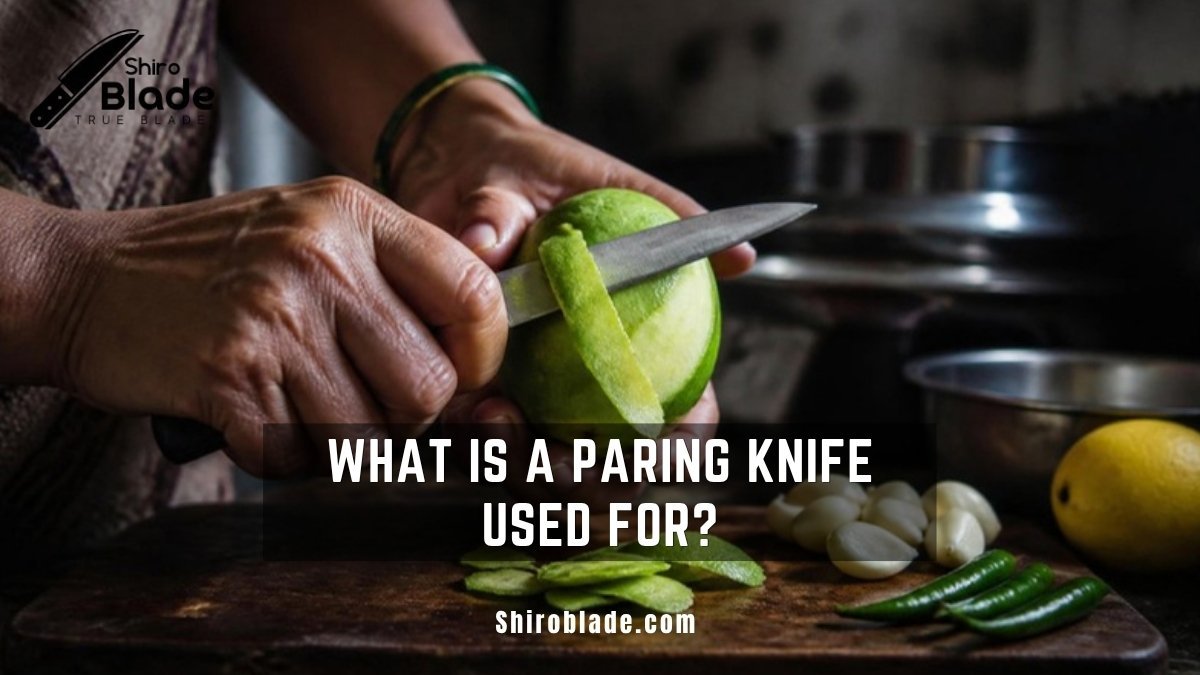
A paring knife is a small knife with a 3 to 4 inch (7.5 to 10 cm) blade made for detail work: peeling, coring, trimming and slitting. It is the knife you pick up when a chef’s knife feels too big for the job, like slitting green chillies or deveining prawns.
This guide covers 12 paring knife uses in an Indian kitchen, what it should never cut, how it compares with other small knives, and how to choose, hold and sharpen one.
Affiliate disclosure: Some links on this page are Amazon.in affiliate links. If you buy through them, I may earn a small commission at no extra cost to you. Read the disclosure.
Short Answer: What Is a Paring Knife Used For?
A paring knife is used for small, precise jobs that need control more than power: peeling fruit and vegetables, coring tomatoes and capsicum, slitting green chillies, peeling garlic and ginger, deveining prawns and cutting garnishes. Much of this work happens in your hand, not on the board. It is not made for bones, pumpkin, coconut or chopping big onions.
| Task | Indian kitchen example | Why a paring knife works |
|---|---|---|
|
Peeling |
Apple, raw mango, potato, ginger |
Short blade gives control in the hand |
|
Coring |
Tomato, capsicum, apple |
Pointed tip turns in tight circles |
|
Slitting |
Green chillies, bhindi for stuffing |
Thin tip makes clean, short cuts |
|
Deveining |
Prawns |
Tip opens the back without tearing the flesh |
|
Trimming |
Beans, drumstick, sambar onions |
Quick, light cuts on the board |
|
Scoring |
Chicken and paneer for marinade |
Shallow, even slits |
What Is a Paring Knife? (Meaning and Size)
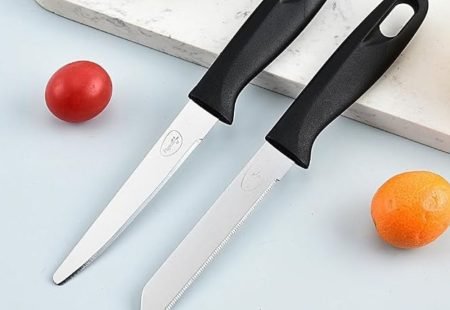
To pare means to trim or peel off the outer layer, and that is exactly the job this knife was designed for. A typical paring knife has a 3-4 inch (7.5-10 cm) blade with a thin, pointed tip, and the whole knife is around 18-20 cm long, so it sits comfortably in your palm.
Most paring knives weigh well under 100 g. That light weight is the point: you hold the food in one hand and guide the blade with your thumb, something a heavy chef’s knife can’t do safely. You can read more about its history and blade shapes on Wikipedia’s paring knife page.
In Japanese cutlery, the closest knife is the petty (a small utility knife), which is usually a little longer at 12-15 cm. Our guide to Japanese kitchen knife types explains where it fits.
12 Paring Knife Uses in an Indian Kitchen
1. Peeling Fruits and Vegetables
Peeling is the main paring knife use. Hold an apple, potato or raw mango in one hand, rest your thumb on the food below the edge and draw the blade towards your thumb in short strokes. You get thinner peels than with a big knife and waste less flesh.
A Y-peeler is faster on carrots and cucumbers, but a paring knife handles uneven shapes like ginger root, mango and pineapple eyes better.
2. Coring Tomatoes, Capsicum and Apples
Push the tip in at an angle around the tomato stem and turn the tomato, not the knife. The core comes out as one small cone. The same move removes the seed core and white ribs from a capsicum before you cut it into strips.
3. Slitting and Deseeding Green Chillies
For bajji, stuffed mirchi or pickles, you need a lengthwise slit that stops before the stem. A paring knife tip does this in one stroke without splitting the chilli in half. Scrape the seeds out with the tip if you want less heat, and wash your hands before you touch your eyes.
4. Peeling and Slicing Garlic and Ginger
Indian cooking goes through a lot of garlic and ginger. Trim the root end of each garlic clove with the tip, then lift the skin off. For ginger, the short blade follows the knobs far better than a chef’s knife, and you can cut thin juliennes right after peeling.
5. Peeling Small Onions for Sambar
Sambar onions (chinna vengayam or shallots) are too small for a big knife. Cut off the top and root with the paring knife, nick the skin and peel it away. Soaking them in water for 10 minutes first makes the skin come off faster.
6. Deveining Prawns
Make a shallow cut, about 2-3 mm deep, along the back of each prawn with the tip and lift out the dark vein. A short, pointed blade gives you far better control than a chef’s knife on something this small and slippery.
7. Removing Potato Eyes and Bruised Spots
Twist the tip into the eye of a potato or a bruised spot on an apple and scoop it out. This is quicker than re-peeling the whole thing and saves food.
8. Trimming Beans, Bhindi and Drumsticks
Topping and tailing beans, trimming bhindi (okra) caps, slitting bhindi for stuffing, and scraping the fibrous skin off drumsticks are all small cuts. The paring knife suits them because you make many quick, light cuts rather than a few heavy ones.
9. Scoring Chicken and Paneer for Marinade
For tandoori chicken or paneer tikka, shallow slits help the marinade go deeper. A paring knife makes neat slashes about 1 cm deep in boneless pieces and drumsticks. Don’t use it to cut through the bone; that is a job for a cleaver.
10. Segmenting Citrus and Cutting Lemon Wedges
Cut the top and bottom off an orange or mosambi, slice the peel away following the curve, then cut between the membranes to free each segment. A paring knife is also the easiest way to cut lemon wedges and flick out the seeds before you squeeze them over dal or salad.
11. Cutting Small Fruit and Removing Seeds
Halving grapes for a lunch box, pitting dates, removing chikoo (sapota) seeds and hulling strawberries are all paring knife jobs. Cut on the board with the tip so your fingers stay away from the edge on slippery fruit.
12. Garnishes and Decorative Cuts
Carrot flowers for a biryani platter, tomato roses or zig-zag cut lemon halves all need a sharp point and a short blade. A bird’s beak (curved) paring knife makes these rounded cuts easier.
What Not to Use a Paring Knife For
A paring knife has a thin blade and a short edge, so it bends or chips under heavy force. Keep it away from these jobs:
Chicken or mutton with bone: use a cleaver or a heavy chef’s knife.
Hard vegetables: pumpkin, yam (senai) and raw jackfruit need a longer, thicker blade.
Coconut: never pry or crack a coconut with the tip; it snaps.
Big onions, cabbage and bulk chopping: the short edge can’t rock, so a chef’s knife is much faster.
Frozen food and bread: frozen meat chips the edge, and bread needs a serrated bread knife.
Paring Knife vs Other Small Knives
| Knife | Blade length | Blade shape | Best for |
|---|---|---|---|
|
Paring knife |
3-4 in (7.5-10 cm) |
Straight edge, pointed tip |
Peeling, coring, slitting, deveining |
|
Bird’s beak (tourne) knife |
2.5-3 in (6-7.5 cm) |
Curved inward like a hook |
Round peeling, garnishes |
|
Tomato knife |
4-5 in (10-12 cm) |
Serrated, often forked tip |
Soft tomatoes, citrus |
|
Utility / petty knife |
5-6 in (12-15 cm) |
Narrow, pointed |
Small veg, sandwiches, boneless meat |
|
Chef’s knife |
6-10 in (15-25 cm) |
Wide, curved belly |
Onions, tomatoes, chicken, herbs |
If you own just one small knife, make it a paring knife. Add a utility knife only if you often cut sandwiches, small vegetables or boneless meat. To see how the big and small knives split the work, read what a chef’s knife is used for.
Types of Paring Knife Blades
Spear point: the most common shape. The tip sits in line with the centre of the blade, so it works for peeling in your hand and for small cuts on the board. Pick this one if you buy only one paring knife.
Sheep’s foot: a straight edge with a rounded spine that drops to the tip. It is safer for beginners and good for straight cuts on the board, but weaker for coring.
Bird’s beak (tourne): a short, hooked blade for round fruit and garnishes. It is awkward to use on a board.
Serrated: small teeth grip tomato skin and citrus peel, and it keeps cutting even when slightly dull. The downside is that serrations are hard to sharpen at home.
How to Hold and Use a Paring Knife
In-hand peeling grip: hold the food in your non-knife hand. Wrap four fingers around the handle and rest your thumb on the food, below the edge. Pull the blade towards your thumb in short, controlled strokes. Your thumb stops the blade; it never sits in its path.
Board grip: for slitting chillies, deveining or trimming, put the food on a board and use a pinch grip, with your thumb and index finger holding the blade just in front of the handle.
Keep it sharp: a dull paring knife slips on mango or tomato skin, and that slip is how most small kitchen cuts happen.
How to Choose a Paring Knife
Blade length: choose 3-3.5 inches (8-9 cm) if you mostly peel in your hand, and up to 4 inches (10 cm) if you do more cutting on the board.
Steel and HRC (hardness): budget knives in 3Cr13 or similar stainless steel (around 52-55 HRC) don’t rust and are easy to sharpen, but they lose their edge sooner. German-style X50CrMoV15 (around 56 HRC) is a good middle ground. Japanese steels like VG10 or SG2 (60 HRC and above) stay sharp the longest, but the thin tip can chip if you twist it in a hard core.
Handle: a light, textured plastic handle gives a safe grip with wet hands. Wooden handles look good but need drying after every wash.
Budget: a good paring knife costs roughly ₹300 to ₹3,000 in India. Many budget sets already include one, so check our knife sets under ₹300 before buying a single knife. For brand comparisons, see the best kitchen knife brands in India.
How to Care for and Sharpen a Paring Knife
Wash by hand and dry right away. In a dishwasher, the thin tip knocks against other utensils and dulls fast.
Cut on wood or plastic. Steel plates, granite tops and glass boards blunt a paring knife within days. Our guide to types of cutting boards explains which boards are kind to an edge.
Sharpen at the right angle. Most Western and Indian knives are sharpened at 15-20 degrees per side, and Japanese knives at about 15 degrees or less. A 1000-grit whetstone sets the edge and a 3000-6000 grit stone polishes it. Hone it on a rod every few uses.
Store it safely. Keep it in a knife block, on a magnetic strip or in a blade guard. A loose paring knife in a drawer ends up with a bent tip.
Conclusion
A paring knife does the small jobs a chef’s knife does badly: peeling, coring, slitting green chillies, deveining prawns and trimming garlic and ginger. Pair it with one all-purpose knife and a bread knife, and you cover almost all Indian home cooking.
Planning the rest of your kit? Our guide to the types of kitchen knives and their uses shows which blades you actually need, and how to choose a kitchen knife covers what to check before you buy.
FAQs
What is a paring knife used for?
A paring knife is used for small, precise jobs: peeling fruit and vegetables, coring tomatoes, slitting green chillies, peeling garlic and ginger, deveining prawns and cutting garnishes.
What is the meaning of paring knife?
To pare means to trim or peel off the outer layer. A paring knife is a small knife with a 3-4 inch blade made for peeling and trimming.
What size is a paring knife?
Most paring knives have a 3-4 inch (7.5-10 cm) blade. A 3-3.5 inch blade is best for peeling in the hand.
Can I use a paring knife to cut vegetables?
Yes, for small items like garlic, chillies, shallots, beans and bhindi. For onions, tomatoes and bulk chopping, a chef’s knife or vegetable knife is faster.
What is the difference between a paring knife and a peeling knife?
A peeling knife (bird’s beak) has a short, curved blade for round fruit. A paring knife has a straight edge and a pointed tip, so it can also core, slit and cut on a board.
Can a paring knife cut meat?
It can trim fat, score chicken and cut small boneless pieces. It should not be used on bones or frozen meat, which can chip or bend the thin blade.
How often should you sharpen a paring knife?
Hone it every few uses. With regular home use, sharpen it on a whetstone every 2-3 months, or sooner if it starts slipping on tomato skin.

Indian knife collector with a deep respect for Japanese knife making. What began as an interest in Damascus patterns grew into a focused study of Japanese knives from Sakai and Seki. Through Shiroblade, I share simple guides on buying, using, and caring for knives, helping readers understand real craftsmanship beyond looks.