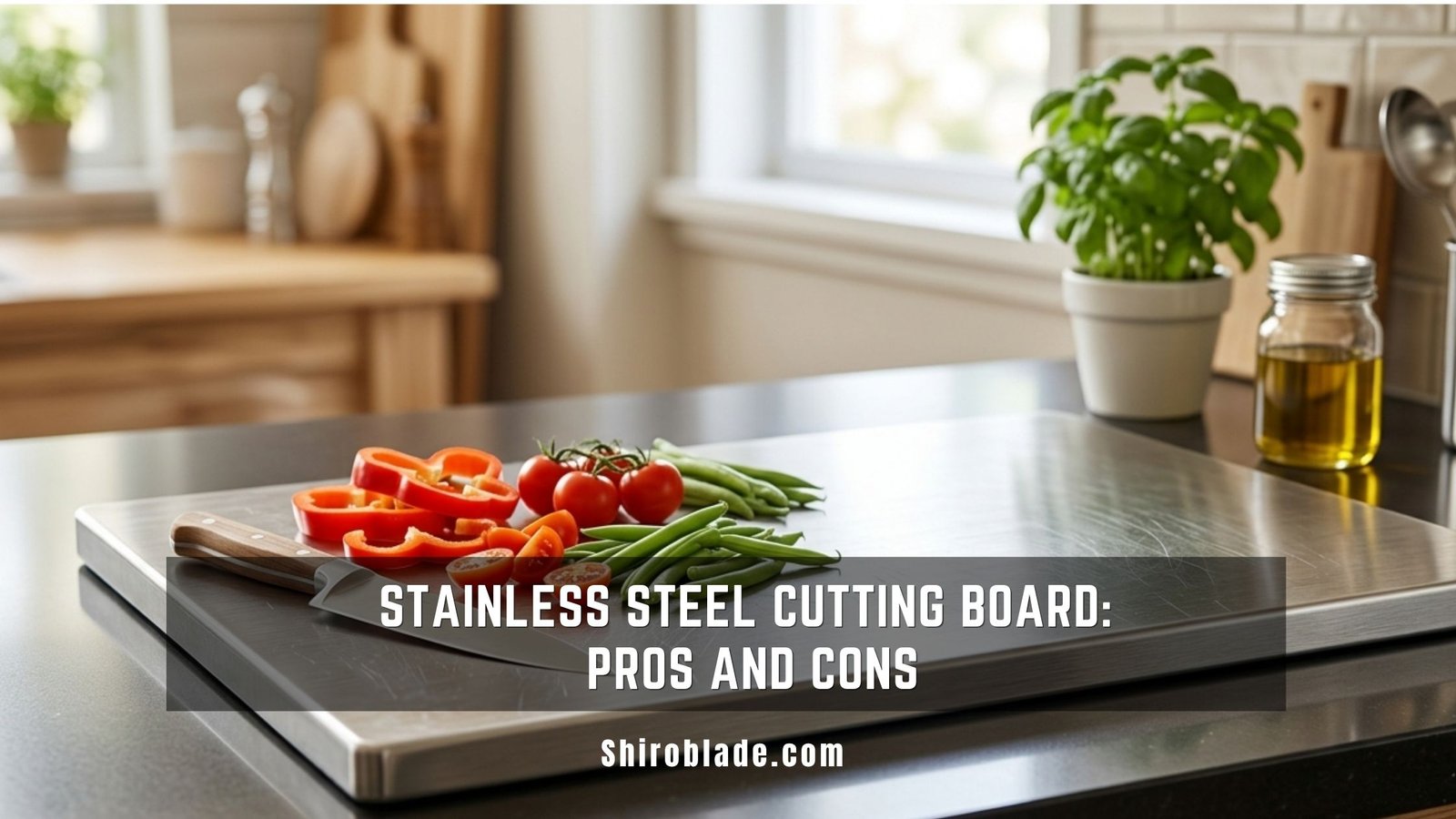
Stainless steel cutting boards have become one of the three most common boards in Indian kitchens, next to wood and plastic. They look clean, never stain with haldi and seem to last forever. But knife owners argue about them more than any other board.
This guide lays out the real stainless steel cutting board pros and cons with material data: what grade of steel it should be, why it affects your knife, and exactly how to use one without dulling your edge.
Short Answer: Is a Steel Cutting Board Worth It?
Yes, if hygiene and durability matter most to you. A 304-grade steel board is non-porous, stain-proof, won’t warp or grow mould, and sheds no microplastics. It is also the best surface in the kitchen for kneading dough and rolling rotis.
The trade-off is knife wear. Steel doesn’t give under the edge, so your knife dulls faster than on wood or plastic. Use slicing strokes, hone more often, and keep thin Japanese knives for a wooden board.
| Pros | Cons |
|---|---|
|
Non-porous, very hygienic |
Dulls knife edges faster |
|
No turmeric stains or smells |
Knife slides on a wet surface |
|
Won’t warp, crack or grow mould |
Loud click while chopping |
|
No microplastics |
Shows fine scratches |
|
Lasts for years, dishwasher-safe |
Costs more than plastic |
|
Ideal for dough and rotis |
Cheap grades (202, 430) can rust |
What Is a Stainless Steel Cutting Board?

A steel cutting board is a flat sheet of stainless steel, sometimes with raised edges, a juice groove or a non-slip base. The grade of steel decides how well it resists rust:
- 304 (food grade): about 18% chromium and 8% nickel. The best choice for a cutting board.
- 202: similar chromium but only about 4 to 6% nickel, replaced by manganese. Cheaper, and more likely to spot or rust with salt, lemon and tamarind.
- 430: no nickel. Magnetic and the least rust-resistant of the three.
Tip: a magnet only tells you if a board is 430. Both 304 and 202 are largely non-magnetic, so check that the listing says 304.
Pros of a Stainless Steel Cutting Board
1. Very Hygienic and Non-Porous
Steel doesn’t absorb raw meat juices, and it doesn’t develop the deep grooves that make plastic hard to clean. The USDA notes that non-porous surfaces are easier to clean than wood. Hot soapy water or a dishwasher cycle cleans it fully.
2. No Turmeric Stains or Smells
Haldi, beetroot, garlic and fish leave nothing behind on steel. For Indian cooking, that alone is why many families switch.
3. Won't Warp, Crack or Grow Mould
Wood can crack in dry weather and grow mould in humid weather. Thin plastic warps with hot water. Steel does none of these, which makes it easy to own in any Indian climate.
4. No Microplastics
A 2023 study in Environmental Science & Technology estimated plastic boards can expose a person to between 7.4 and 50.7 g of microplastics a year. Steel sheds no plastic at all.
5. Lasts for Years
A good 304 board can outlast several plastic boards and needs no oiling or sanding. It is also dishwasher-safe.
6. Best Surface for Dough and Rotis
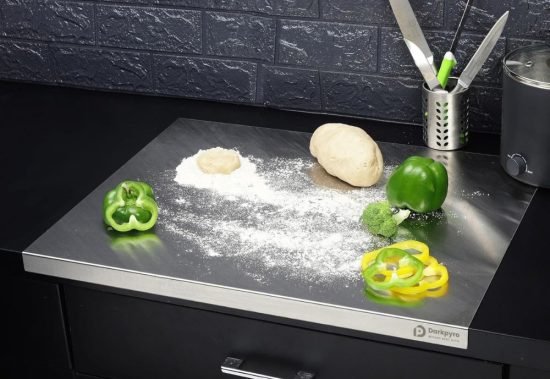
Steel is smooth and stays cool, so atta and maida dough don’t stick as much. One board can work as your chopping board, chakla and serving tray.
Cons of a Stainless Steel Cutting Board
1. Your Knife Dulls Faster
This is the big one, and it’s often misunderstood. Annealed 304 steel is rated at no more than about 92 on the Rockwell B scale, which is much softer than a kitchen knife at 56 to 62 HRC. So steel won’t chip your knife the way glass or granite can.
The problem is that steel doesn’t give. On wood or plastic, the edge sinks in slightly and stops. On steel, the very fine apex takes the full impact of every chop and bends over. You’ll feel the knife get dull in days instead of weeks. Hard Japanese steels like VG10 and SG2 (60+ HRC) can also micro-chip on a rigid surface.
2. The Blade Slides on a Wet Surface
Wet steel is slippery, and a knife that skates sideways on a tomato or onion is a safety risk. Choose a board with a textured surface or a non-slip base, and wipe it dry as you work.
3. Noise and Feel
Every chop makes a metal-on-metal click. It’s harmless, but many cooks find it tiring over a long prep session.
4. Fine Scratches Show
Steel boards get fine knife marks over time. They are shallow and don’t trap food like plastic grooves, but the board won’t stay mirror-bright.
5. Cheap Grades Can Rust
202 and 430 boards can show rust spots, especially with salt, lemon or tamarind left on them. Always buy 304 and dry the board after washing.
How to Use a Steel Cutting Board Without Ruining Your Knife
- Slice, don’t chop. Use a forward push or pull stroke so the edge glides instead of hammering down.
- Hone more often. A honing rod realigns a rolled edge in a few strokes. Do it every 2 to 3 uses.
- Keep Japanese knives off it. Use your VG10, SG2 or Damascus knife on wood or plastic.
- Use a budget knife on steel. A softer stainless knife (around 54 to 56 HRC) tolerates steel better and is easy to resharpen.
- Put a damp cloth under it if the base isn’t non-slip.
- Never use a cleaver on steel. Bone chopping on steel bounces the blade and damages both.
Steel vs Wood vs Plastic Cutting Boards
| Factor | Steel | Wood | Plastic |
|---|---|---|---|
|
Knife-friendliness |
Fair (dulls faster) |
Very good |
Good |
|
Hygiene |
Excellent |
Good with care |
Very good when new |
|
Turmeric stains |
None |
Stains |
Stains |
|
Microplastics |
None |
None |
Yes |
|
Care |
Wash and dry |
Wash, dry, oil |
Wash only |
|
Lifespan |
Many years |
Many years |
1 to 2 years |
|
Best for |
Hygiene, dough, light slicing |
Vegetables, knife care |
Raw non-veg, budget |
For the full comparison of the other two, read plastic vs wood cutting board, or see all 9 materials in our types of cutting boards guide.
Who Should Buy a Steel Cutting Board (and Who Shouldn't)
Buy one if you:
- Want the most hygienic, stain-free board for daily Indian cooking
- Live in a humid city where wooden boards grow mould
- Want one board for chopping, dough and serving
- Use budget stainless knives you sharpen regularly
Skip it if you:
- Own Japanese, Damascus or high-HRC knives you want to keep razor-sharp
- Chop hard and fast and dislike the noise
- Cut bone-in chicken with a cleaver
How to Clean and Care for a Steel Cutting Board
Wash with hot soapy water or run it through the dishwasher, then dry it fully, especially around the edges and any juice groove. Don’t leave salt, lemon or tamarind on it for long. For water spots, wipe with a little vinegar and rinse. Avoid steel wool, which leaves scratches where rust can start.
Conclusion
A 304 stainless steel cutting board is the most hygienic, stain-proof and long-lasting board you can buy, and it sheds no microplastics. Its only real weakness is knife wear, and slicing strokes plus regular honing take care of most of it. If you own expensive Japanese knives, pair steel with a wooden board.
Comparing board options? See our top picks in best chopping boards in India, or our best wooden chopping boards in India to pair with steel. Ready to buy? See our 6 best stainless steel vegetable cutting boards in India.
FAQs
Are steel cutting boards good?
Yes, for hygiene and durability. A 304 steel board is non-porous, stain-proof and long-lasting. The trade-off is that knives dull faster on steel than on wood or plastic.
Do steel cutting boards damage knives?
They don’t chip most knives, because 304 steel is softer than knife steel. But steel doesn’t give, so the edge rolls and dulls faster. Slice instead of chop, and hone often.
Which steel grade is best for a cutting board?
304 food-grade stainless steel, with about 18% chromium and 8% nickel. Avoid 202 and 430, which are cheaper and rust more easily.
Is a steel cutting board better than plastic?
Steel is more hygienic, doesn’t stain, lasts longer and sheds no microplastics. Plastic is cheaper and kinder to your knife edge.
Can I cut meat on a steel cutting board?
Yes, steel is very hygienic for boneless meat and fish. Don’t use a cleaver on bone-in chicken on steel; use a heavy plastic or wooden board for that.
How do I stop my knife slipping on a steel board?
Choose a board with a textured surface or non-slip base, keep it dry while cutting, and put a damp cloth underneath if it moves.

Indian knife collector with a deep respect for Japanese knife making. What began as an interest in Damascus patterns grew into a focused study of Japanese knives from Sakai and Seki. Through Shiroblade, I share simple guides on buying, using, and caring for knives, helping readers understand real craftsmanship beyond looks.