
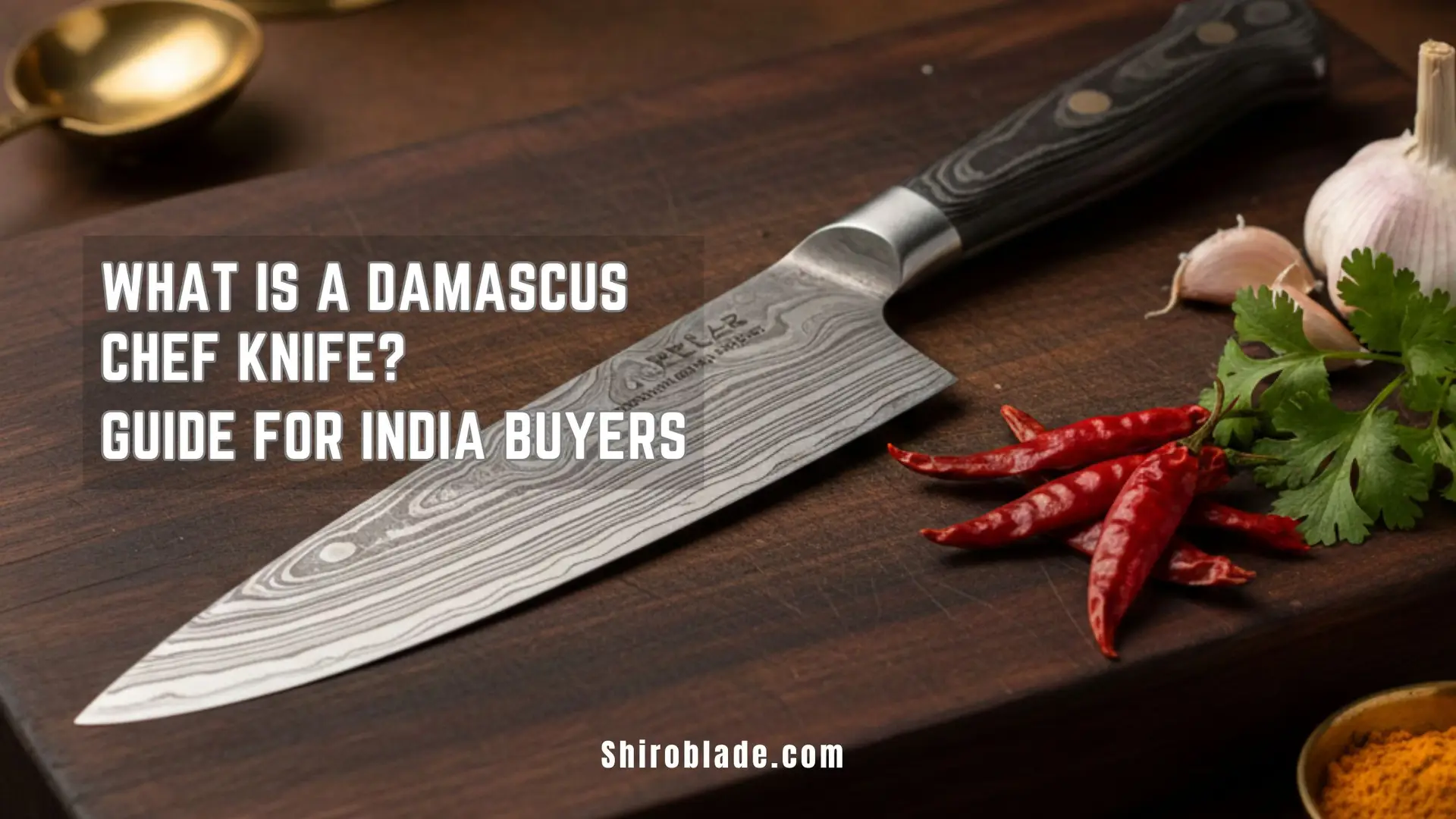
If you have ever seen a knife with beautiful, wavy swirls on the blade that look like flowing water or wood grain, you were likely looking at a Damascus knife. These knives are famous around the world not just because they look like pieces of art, but because they have a reputation for being some of the best tools a cook can own.
In this guide, we will answer all your questions about these blades, from how they are made to how much you should expect to pay for one.
Are Damascus Knives Good for Kitchen?
When people first see these patterns, the first thing they ask is: are damascus knives good, or are they just for show?
The short answer is yes, they are excellent. A high-quality Damascus chef knife is a workhorse in the kitchen. While it is a great all-rounder, it is just one of the many specialized Japanese kitchen knife types used by professionals. Because they are made by layering different types of steel together, they get the “best of both worlds.” One type of steel might be very hard to keep a sharp edge, while another type is tough so the knife doesn’t snap.
When these are joined, you get a blade that stays sharp for a long time and can handle heavy daily use. Beyond the strength, they are also a joy to use. Most chefs feel more inspired to cook when they are using a tool that looks as good as it performs.
How are Damascus blades made?
To understand the value of these knives, you have to look at the history of ancient Damascus steel and know how these damascus blades are made. It is a very long and difficult process.
In modern times, smiths use a method called “Pattern Welding.” Here is the simple version of how it works:
-
Stacking: The blacksmith takes several pieces of different types of steel and stacks them on top of each other.
-
Heating: The stack is put into a fire until it is glowing hot.
-
Hammering: This forge welding process fuses the pieces into one single block
-
Folding: This is the secret step. The smith folds the steel over and hammers it flat again. Every time they fold it, the number of layers doubles.
-
Acid Etching: At the very end, the knife is dipped in a special acid. Because the different steels react differently to the acid, the beautiful wavy lines become visible.
Difference Between Japaense Damascus Knife and Chineese made damacus Knives
When you look for a knife online, you will see two very different worlds. One is the high-quality Japanese tradition, and the other is the mass-produced Chinese market. It is vital to know the difference so you don’t waste your money.
1. Original Japanese Layered Damascus
This is the real deal. Japanese makers use a method called “San Mai” or “Pattern Welding.” They take a very hard center steel (the core) and wrap it in many layers of softer, beautiful Damascus steel.
-
The Process: These layers are folded and hammered together. The pattern you see is part of the metal itself.
-
The Performance: Because it is real layered steel, the knife is incredibly sharp and strong. If you sand the blade down, the pattern will still be there because it goes all the way through.
2. Chinese "Laser Crafted" Damascus (The Fake Look)
Many cheap knives coming from large factories in China are not actually Damascus at all. They are regular, plain stainless steel knives made to look expensive.
The Process: Instead of folding layers of metal, they use a laser to draw or “print” a wavy pattern on the surface of the blade.
The Performance: These knives do not have the strength or sharpness of real Damascus. They are just basic kitchen knives. The biggest problem is that the “pattern” is only on the surface. If you scratch the blade or polish it, the pattern will actually rub off.
How to tell the difference between chinese made and japaneese made?
The Price: Real Japanese layered knives usually cost more than ₹8,000. If you see a “Damascus” knife for ₹1,000 to ₹2,000, it is almost certainly a Chinese laser-etched fake.
The Spine: Look at the top edge (the spine) of the knife. On a real Japanese knife, you can see the layers of steel. On a fake Chinese knife, the top is usually plain and smooth.
The Look and Finish: Be careful of knives that look “too perfect.” Cheap Chinese-made knives are often made to look very fancy to trick buyers. They are usually polished to a mirror finish and are as shiny as glass. They also use very colorful, bright, and fancy-looking handles made of cheap plastic or resin. Real Japanese knives usually have a more natural, professional look where the focus is on the quality of the steel, not just the “sparkle.
Is damascus steel good for kitchen knives?
You might wonder, is damascus steel good for kitchen knives compared to the regular knives you find at a grocery store?
The answer is a big yes. In a kitchen, you want a knife that is “thin and a bit flexible” but also “hard and sharp.” Because Damascus steel uses layers, it can be made very thin without becoming brittle. This makes it perfect for slicing through vegetables like tomatoes or onions with almost no effort.
Differences Between Damascus Knives vs. Stainless Steel Knives
Most people are used to standard stainless steel knives. Here are the main differences:
| Feature | Damascus Chef Knife | Standard Stainless Steel |
|---|---|---|
|
Sharpness |
Stays sharp for a very long time. |
Dulls faster; needs sharpening often. |
|
Look |
Unique, beautiful wavy patterns. |
Plain, shiny silver look. |
|
Care |
Needs to be dried immediately. |
Can handle being wet for a while. |
|
Strength |
Very hard and stiff. |
More flexible and “soft.” |
If you want a knife that you never have to worry about, stainless steel is fine. But if you want a knife that performs at a high level and feels special, Damascus is the winner.
How many layers damascus steel knife have?
A common question is “how many layers damascus steel knife have” professionals usually prefer. You might see knives that claim to have 33 layers, 67 layers, or even over 100 layers.
33 Layers: Usually 16 layers on each side with a hard core in the middle.
67 Layers: This is the most common “high-quality” count. It provides a very detailed and beautiful pattern.
The Truth: More layers do not always mean a better knife. Once you get past 60 or so layers, it doesn’t make the knife much stronger; it just changes how the pattern looks. A 67-layer knife is usually the “sweet spot” for most cooks.
What is the cost of a damascus chefs knife in india?
When shopping in India, you will notice a huge range in price. So, what is the cost of a damascus chefs knife? Here is a breakdown in Indian Rupees (INR):
Budget (₹5,000 – ₹10,000): These are usually factory-made. They look very nice and have the wavy patterns, but the steel might be a bit softer. Be careful here, as some knives under ₹2,000 might just have the pattern “printed” on them, which is not real Damascus.
Mid-Range (₹12,000 – ₹20,000): This is the best choice for most people. These knives usually have a very high-quality steel core (like VG-10) and genuine folded layers. They are professional-grade tools.
Custom Handmade (₹25,000 – ₹80,000+): These are made by master blacksmiths. You are paying for the artist’s time, the best materials, and a unique design that no one else in the world owns.
What To Look For When Shopping For A Damascus Chef Knife In India?
If you are looking to buy one of these blades in India, you need to be very careful. There is no large-scale manufacturing of high-quality Damascus knives in India. This means that every Damascus knife you see for sale in the Indian market is imported—usually from either Japan or China.
To make sure you get a real tool and not a cheap decoration, here is what you should look for:
1. Avoid Cheap Chinese-Made “Fakes”:
As we discussed, if the price is too low (like ₹1,500), it is likely a mass-produced Chinese knife. These are often made of soft steel and use a laser to “print” a fake pattern on the surface. They won’t stay sharp and the pattern will eventually disappear.
2. Don’t Be Fooled by “Shiny” Blades:
Many low-quality sellers try to trick you with looks. Avoid knives that are polished to a mirror finish and are shiny like glass, or knives with very bright, colorful plastic handles. Real professional knives focus on the quality of the metal, not just looking like a toy.
3. Identify the Core Steel:
A real Damascus knife is built like a sandwich. It has a very hard “core” steel in the middle that does the cutting. Look for names like VG-10, AUS-10, or SG2. If the seller does not mention what the core steel is, it is likely a cheap imitation.
4. Check the Pattern on the Spine:
Always look at the top edge (the spine) of the knife. On a real layered knife, you will see the layers of metal stacked on top of each other all the way through. If the spine is perfectly smooth and plain, the pattern on the side is just a laser drawing.
5. Look for Traditional Handles and Origin:
Since these are all imported, ask the seller where the knife comes from. Japanese-made knives are the gold standard and almost always feature traditional wooden handles (like Magnolia or Walnut). They feel balanced and professional, unlike the flashy, cheap imports designed only for looks.
How to clean damascus chef knife?
Because these knives are special, you cannot treat them like a cheap spoon. You must know how to clean damascus chef knife properly so it doesn’t ruin.
Never use the dishwasher: The heat and harsh soap will dull the blade and ruin the pattern.
Hand Wash Only: Use warm water and mild dish soap.
Dry Immediately: This is the most important step! If you leave it in the drying rack wet, it can develop rust spots. Use a soft towel to dry it as soon as you are done washing.
Mineral Oil: Every few months, rub a tiny bit of food-safe mineral oil on the blade. This keeps the steel protected from moisture in the air.
Conclusion
A Damascus chef knife is more than just a kitchen tool; it is a piece of history you can use every day. Whether you choose one for its incredible sharpness or its beautiful patterns, taking care of it will ensure it lasts for a lifetime.

Indian knife collector with a deep respect for Japanese knife making. What began as an interest in Damascus patterns grew into a focused study of Japanese knives from Sakai and Seki. Through Shiroblade, I share simple guides on buying, using, and caring for knives, helping readers understand real craftsmanship beyond looks.

Pingback: Why Japanese Knives Are So Expensive? Are They Actually Worth the Price?
Pingback: Real vs Fake Damascus: 5 Ways to Tell if Your Damascus Knife is Authentic
Pingback: Japanese Kitchen Knife Types : The Right Blade for Every Task
Pingback: 10 Best Kitchen Knife Brands in India 2026
Pingback: Types of Damascus Steel Explained: It’s More Than Just the Pattern