You are currently viewing The Damascus Blade Pattern Myth: There Is No Such Thing

The Damascus Blade Pattern Myth: There Is No Such Thing

If you search for a Japanese kitchen knife, you will find dozens of articles explaining the “Different Types of Damascus Patterns.” They list things like Raindrop, Ladder, Feather, and Twist as if they are official categories.

Here is the blunt truth: There are no “standard” types of Damascus balde patterns. In the world of authentic Sakai blacksmithing, “Damascus Types” do not exist. Those names are a marketing invention used by machine-built factories to make their mass-produced knives look official.

It’s Not a Design, It’s a Process

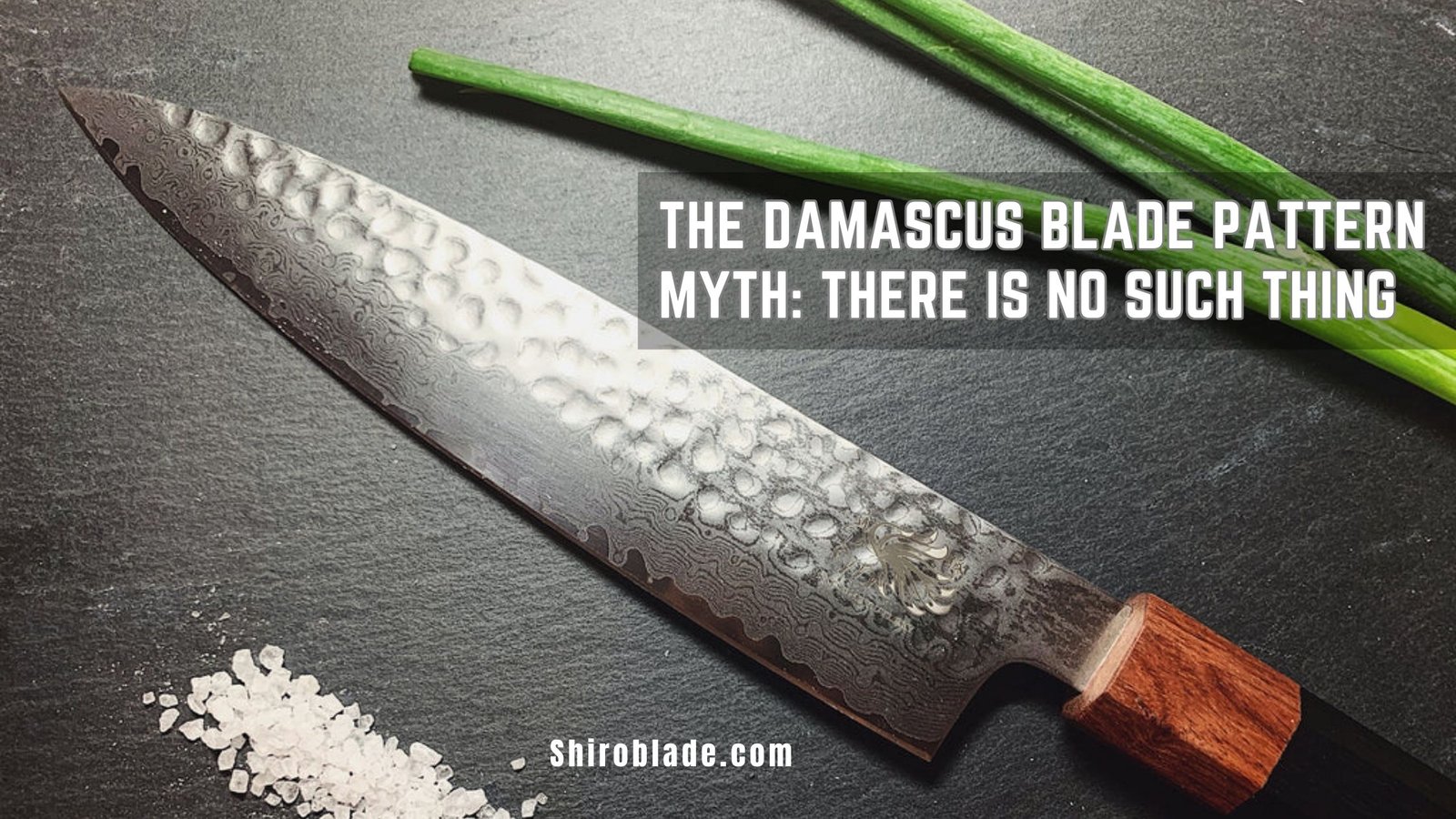
When a master smith in Japan hammers layers of steel together, he isn’t following a “pattern guide.” He is simply folding and forging. The resulting look is called Suminagashi (floating ink). It is organic, random, and accidental.

The moment someone tries to sell you a “Standard Ladder Pattern,” they are telling you that their knife was made by a machine. Why? Because you can only get a “standard” look if you use a computer-controlled laser or a factory stamp.

Why These 4 "Types" are Bullshit:

1. The Ladder Pattern:

People say this is a “style.” In reality, if the rungs look like a perfect ladder, it was etched by a machine. A real hand-forged knife has no “rungs”—it has unique waves.

2. The Raindrop Pattern:

Blogs claim this is a “choice.” But in a real forge, “drops” are just where the hammer hit the metal differently. If the dots are perfectly round and even, it is a fake “wallpaper” design.

3. The Feather Pattern:

This is marketed as a “luxury type.” In reality, it is a theoretical concept. If a knife has a perfect feather look and costs less than a bicycle, it’s a printed lie.

4. The Twisted Damascus:

Factories call this a “classic type.” But a real twist is a physical mess of steel under tension. It doesn’t look like a neat “design”—it looks like a storm.

Authentic Knives Have No Name

When you buy a real Sakai-made knife, you won’t see it labeled as “Raindrop Type.” You will see it labeled by the maker’s name and the steel type (like Blue Super or SG2).

A real blacksmith doesn’t try to force the steel to look like a “Feather.” He lets the steel show its own unique face. This is why every real Japanese knife is different. If you can name the pattern, it’s probably a factory-made fake.

The Only Names You Need to Know

Instead of looking for “pattern types,” look for the masters who forge the steel by hand. These names represent real Suminagashi, not “standard” designs:

  • Sakai Takayuki

  • Yu Kurosaki

  • Takeshi Saji

  • Yoshimi Kato

  • Shigeki Tanaka

  • Tetsujin Hamono

  • Hado Sakai

  • Konosuke

  • Sakai Kikuichi

  • Suminagashi

Bottom Line

The next time you see a blog post explaining the “3 Types of Damascus Patterns” or “4 Types of  Damascus Patterns,” close the tab. Those patterns only exist in factories. A real Japanese blade has no pattern “type”—it only has the soul of the smith who hammered it.

This Post Has One Comment

Leave a Reply