
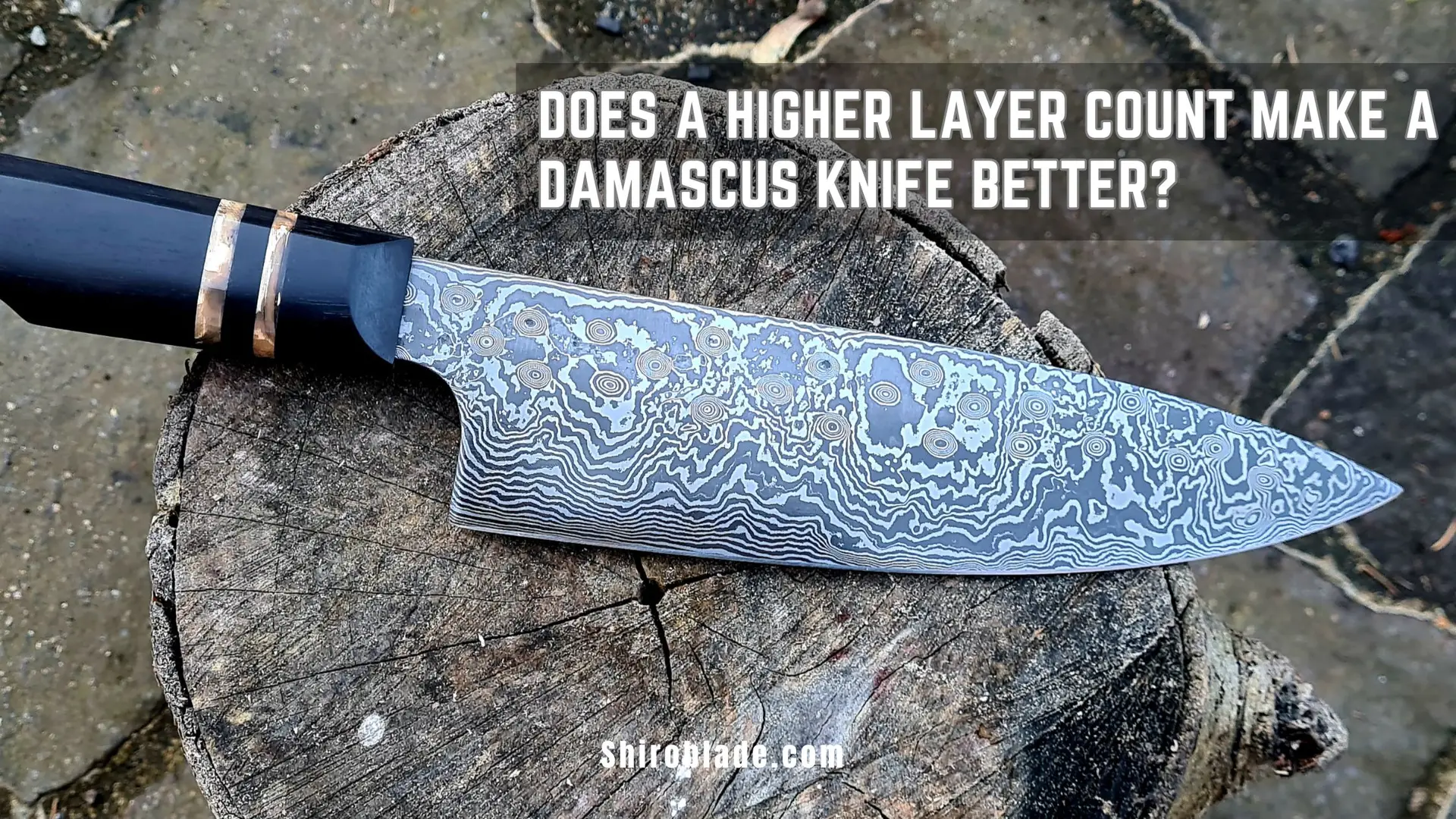
Does a Higher Layer Count Make a Damascus Knife Better?
No. A higher layer count does not make a Damascus knife sharper or stronger. While a high number of layers looks beautiful, it is mostly for style. The actual cutting performance depends on the quality of the steel in the very center of the blade.
Understanding the "Sandwich" Construction
To understand layers, imagine a Damascus knife like a sandwich:
1. The Filling (The Core):
In the very middle of the knife, there is one solid piece of very hard steel. This is the Core. It is the only part of the knife that creates the sharp edge and does the actual cutting.
2. The Bread (The Layers)
The “Damascus” part is actually two pieces of layered steel wrapped around that core to protect it. When a brand says “67 layers,” they are counting these outer decorative layers.
Why Do Knives Have Layers at All?
If the layers don’t make it sharper, why are they there?
Protection: The hard core steel is great for cutting but can be brittle (it can chip easily). The softer Damascus layers act as a shock absorber to keep the knife from breaking.
The Pattern: By folding different types of steel together, blacksmiths create those famous wavy, water-like patterns.
Non-Stick: On some knives, the texture of the layers helps food (like potatoes or onions) slide off the blade more easily.
Why "More" Isn't Always "Better"
When you are shopping, you will see knives with 16, 33, 67, or even 100+ layers. Here is the truth:
Marketing vs. Reality: A knife with 100 layers isn’t “twice as good” as one with 50. Once you have enough layers to protect the core, any extra layers are just for a more intricate design.
The “Sweet Spot”: Most high-quality Japanese knives from famous regions like Sakai use 33 or 45 layers. This provides the perfect balance of beauty and protection.
Quality Over Quantity: A cheap, factory-made knife with 100 layers will still perform worse than a 33-layer knife hand-forged by a master Japanese blacksmith.
Summary Checklist for Beginners
When buying a Damascus knife, don’t just look at the layer count. Look for these terms instead:
| Feature | Checklist |
|---|---|
|
Core Steel: |
Look for names like VG-10 or SG2. This tells you the “meat” of the knife is high quality. |
|
Origin |
Knives from Sakai, Japan are world-renowned for their craftsmanship. |
|
The Pattern |
If the pattern looks too perfect or “printed,” it might not be real Damascus. Real Damascus patterns are unique to every knife. |
Final Verdict
Choose a Damascus knife because you love the pattern and the artistry, but don’t pay extra money just for a “higher number.” Focus on the core steel and the maker to ensure you get a knife that actually cuts well.

Indian knife collector with a deep respect for Japanese knife making. What began as an interest in Damascus patterns grew into a focused study of Japanese knives from Sakai and Seki. Through Shiroblade, I share simple guides on buying, using, and caring for knives, helping readers understand real craftsmanship beyond looks.

Pingback: How Much Does a Real Damascus Knife Cost
Pingback: What is a Damascus Chef Knife? Guide for India Buyers
Pingback: 10 Best Kitchen Knife Brands in India 2026
Pingback: The Damascus Blade Patterns Myth: There Is No Such Thing
Pingback: Types of Damascus Steel Explained: It’s More Than Just the Pattern