
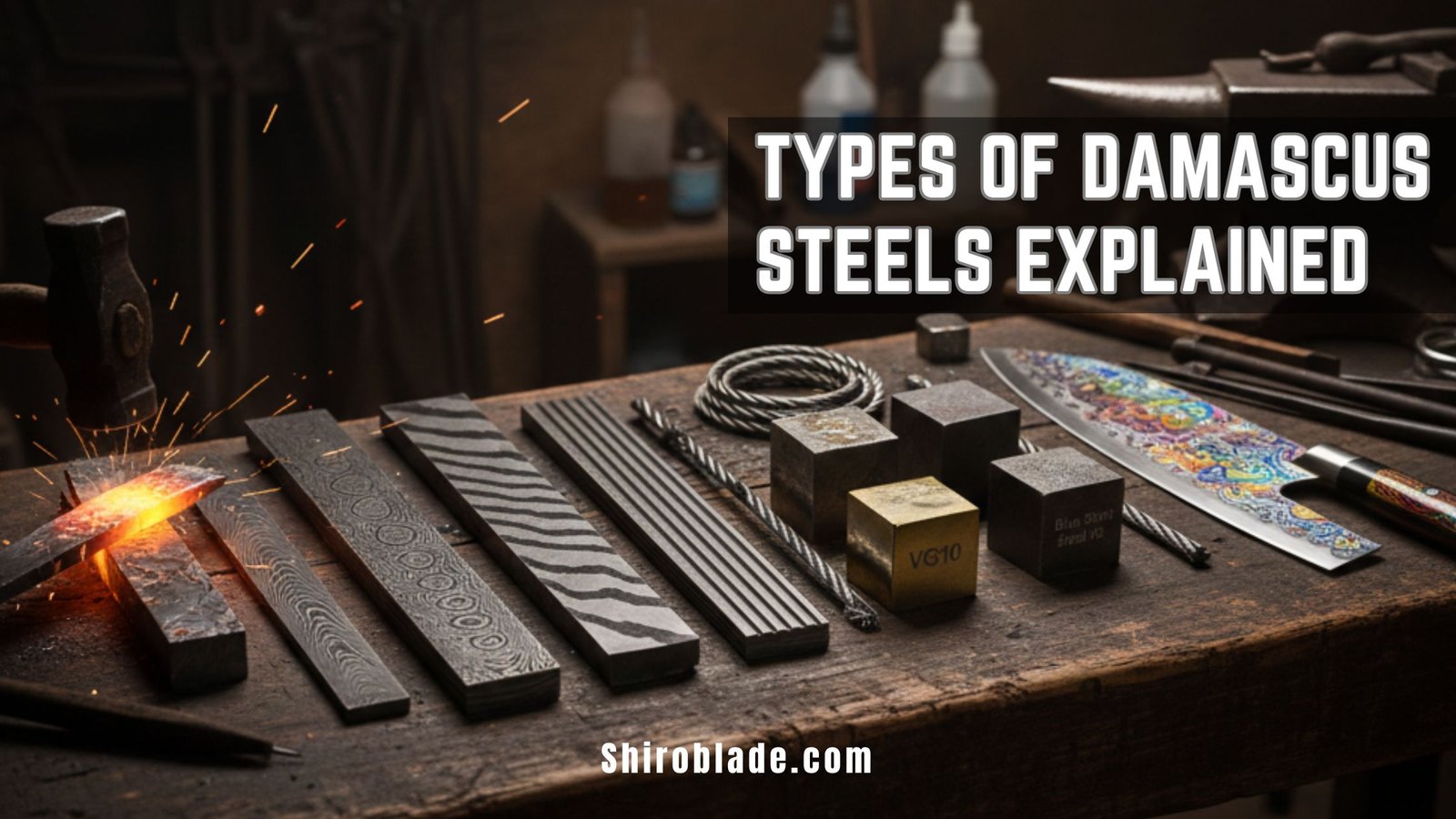
When most people buy a Damascus knife, they are choosing a “look.” But for the serious enthusiast, the pattern is just the surface. To understand the true value of a blade, you have to look at the metallurgy.
“Damascus Steel” is not a single type of metal; it is a composite. It is a combination of different steels forged together to achieve a balance of beauty, hardness, and toughness.
Types of Damascus Steel
This guide explains the actual types of steel used in the forge and how they define the blade’s performance.
1. The Three Main Production Methods
Before we talk about specific alloys, we have to define how the Damascus is made. This is the “How” behind the “What.”
Pattern-Welded Steel: This is the accurate name for 99% of modern Damascus. It involves stacking layers of different steels into a Billet, heating them, and forge-welding them into a single piece of Laminated Steel.
Crucible Damascus (Wootz): The historical “original.” This wasn’t layered. Instead, it was melted in a crucible, creating internal “carbide” patterns. It is extremely rare and artisanal today.
Stainless Damascus (Damasteel): A modern high-tech version. Instead of forge-welding bars of steel, it uses powder metallurgy to fuse stainless alloys at a molecular level. It is the gold standard for rust-resistant Damascus.
2. The Carbon Steel Duo: Creating the Contrast
Most Damascus knives use a combination of two specific steels. The “type” of Damascus is often defined by the chemical dance between Carbon (for darkness) and Nickel (for shine).
High-Carbon Steels (The Dark Layers)
These provide the structural integrity and turn dark when dipped in acid (the etch).
1095: The industry favorite. It provides the deepest black contrast.
1084 / 1075: Reliable, high-carbon steels that are easier for blacksmiths to heat-treat.
52100: Originally ball-bearing steel; it adds incredible wear resistance to a Damascus mix.
W2: A water-hardening tool steel that produces a razor-sharp, fine-grained edge.
High-Nickel Steels (The Bright/Shiny Layers)
Nickel resists acid. While the carbon steel turns black, these layers stay silver.
15N20: The standard companion for 1095. It contains 2% nickel and creates the “white” lines in the pattern.
L6: A tough tool steel that provides a bright, durable shine.
Nickel 200: Pure nickel used for “Extreme Contrast” in art knives (though it does not harden well).
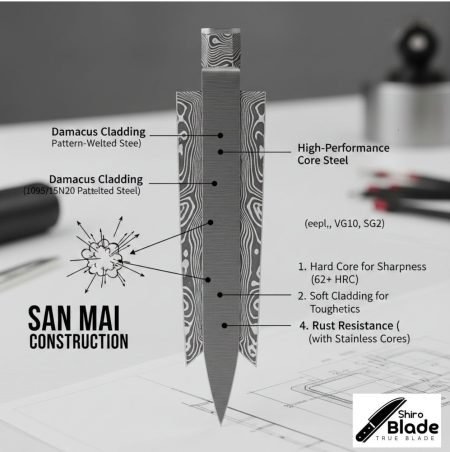
3. The Core Steels: The Secret of Japanese "San Mai"
In high-end Sakai and Japanese knives, the Damascus is actually a Cladding (a jacket). It protects a solid “Core” of high-performance steel that does the actual cutting.
High-Performance Stainless Cores
VG10: The most famous Japanese stainless core. Great edge retention and total rust resistance.
AUS-10: A tough, modern Japanese alternative that is slightly easier to sharpen than VG10.
SG2 / R2: A “Super Steel” made via powder metallurgy. It is ultra-hard (64 HRC) and stays sharp for months.
Traditional Carbon Cores (The Sakai Choice)
Blue Steel #2 (Aogami): Favored for its “silky” cutting feel and extreme toughness.
White Steel #2 (Shirogami): The purest carbon steel. It achieves the sharpest possible edge but requires constant oiling to prevent rust.
HAP40: A semi-stainless high-speed tool steel with world-class edge retention.
4. Modern Stainless Damascus Alloys
If you want the beauty of a damascus pattern without the maintenance of carbon steel, you look for Stainless Damascus.
RWL34 & PMC27: These are the two specific alloys used to create Damasteel (Swedish powder Damascus).
440C: A classic stainless alloy often used in durable, mid-range Damascus blades.
5. Historical & Artisanal Bases
Sometimes, the steel type is defined by its origin or unique forging process:
Tamahagane: The “Jewel Steel” used in traditional Japanese swords, smelted from iron sand.
Wrought Iron: Often used in traditional Japanese cladding to provide flexibility to a brittle steel core.
Industrial Cable: Known as Cable Damascus, created by forge-welding repurposed wire rope into a single blade.
Conclusion: It’s What’s Inside That Counts
When choosing a Damascus knife, remember that the pattern is only half the story. To truly understand the “type” of Damascus you are holding, you must look at the metallurgy—the specific combination of steels used in the forge.
Whether you prefer the high-contrast drama of a 1095 and 15N20 carbon mix, the rust-resistant innovation of Damasteel, or the precision performance of a Sakai blade with a VG10 or Blue Steel core, the steel defines the soul of the knife. By looking beyond the surface aesthetics and focusing on the core materials and construction methods, you can ensure your next blade isn’t just a work of art, but a high-performance tool built to last a lifetime.

Indian knife collector with a deep respect for Japanese knife making. What began as an interest in Damascus patterns grew into a focused study of Japanese knives from Sakai and Seki. Through Shiroblade, I share simple guides on buying, using, and caring for knives, helping readers understand real craftsmanship beyond looks.

Pingback: 7 Best Damascus Knives in India: Top Choices to Buy - ShiroBlade