
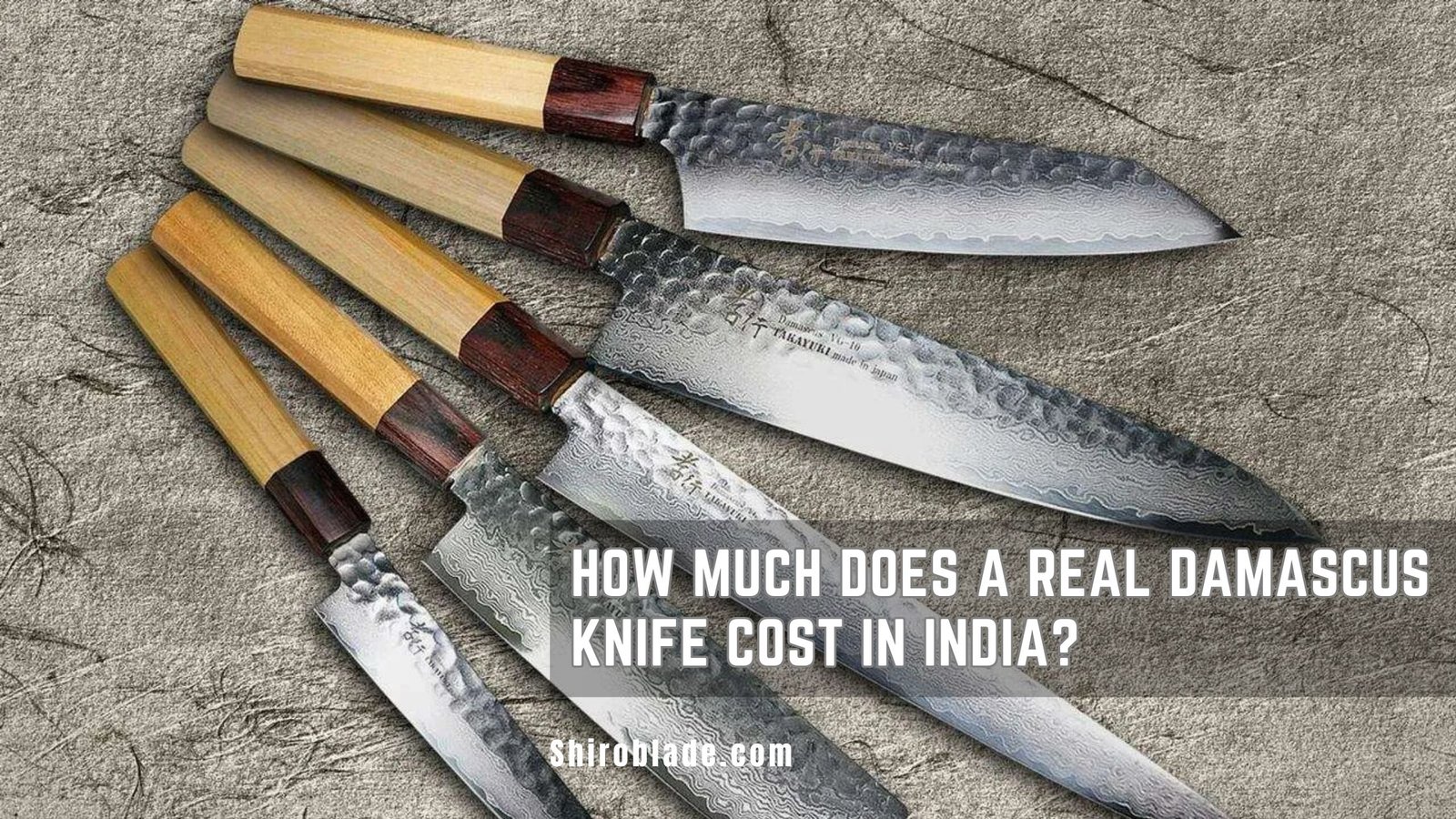
Are you dreaming of that exquisite Damascus blade—the one with the mesmerizing patterns and legendary sharpness—gracing your Indian kitchen? You’ve likely scrolled through Amazon India, Flipkart, and perhaps even some international sites, only to be met with a bewildering array of “Damascus” knives ranging from ₹20,000 to ₹60,000.
But what’s the real story? What is the actual cost of bringing a truly authentic, hand-forged Japanese Damascus knife to your doorstep in India? Let’s peel back the layers.
The Allure of Damascus: More Than Just a Pattern
First, let’s clarify what a “real” Damascus knife is. We’re talking about blades crafted through a painstaking process of pattern-welding different types of steel, often up to 33 or 67 layers, folded and hammered repeatedly.
This creates the distinctive wavy patterns, but more importantly, it combines properties like hardness and flexibility, resulting in a blade with incredible edge retention and strength. Many of these highly sought-after blades come from Japan, particularly regions like Sakai and Seki, where master smiths have honed their craft for generations.
The "Alibaba" Trap: How Local Sellers Fool Indian Customers
You might have noticed knives on platforms like Amazon India or Flipkart titled as “Authentic Japanese Damascus Knife” with prices as low as ₹1,000 to ₹3,000. If you look at the specifications, however, the material is often listed simply as “Stainless Steel.”
This is a major red flag that points to a common scam in the Indian market where sellers exploit the gap between real vs fake Damascus knives to move cheap inventory.
The Alibaba Reseller Loop: Most of these “Japanese” knives never saw Japan. Local sellers buy these in bulk from Alibaba (China) for $5 to $15. These are mass-produced in Chinese factories (often in Yangjiang), stamped out by machines, and shipped to India to be rebranded as “Handmade” or “Japanese.”
Laser-Etched Imposters: To get that famous Damascus look at such a low price, manufacturers use a laser to print a wavy pattern onto a single layer of cheap stainless steel. There are no actual layers of steel, no forge-welding, and zero performance benefits. It is essentially a “sticker” made of burnt metal on a standard budget knife.
Genuine “Stainless Damascus”: In contrast, a real high-quality Japanese knife (like those from Sakai) uses a hard steel core (like VG-10) sandwiched between 33 or 67 layers of real stainless steel. These are authentic, layered, and expensive.
The "Made in India" Quandary: Understanding Brands like Kai India
While Kai Corporation is a renowned Japanese company, Kai India operates manufacturing facilities within India. Many of their “Japanese style” or “Damascus pattern” knives sold in the Indian market are:
Machine-made in India: Mass-produced in Indian factories, not hand-forged in Japan.
Laser-Etched: Their “Damascus” patterns are often purely cosmetic, created by laser or acid etching on a single piece of steel.
The Verdict: They offer decent performance for the price, but they are not the artisanal, hand-made, true layered Damascus knives from Sakai. They are essentially the high-quality version of mass-produced Chinese knives, made locally.
The True Cost: Importing a Real Sakai Blade to India
Let’s get down to the numbers for an authentic, hand-forged Japanese Damascus knife (e.g., a high-quality Gyuto from Sakai). A mid-range, 210mm Gyuto with a VG-10 core and 67 layers typically costs around $250 USD at its source.
Here is how that price escalates by the time it reaches India:
| Component | Calculation | Estimated Cost (INR) |
|---|---|---|
|
Base Knife Price |
$250 USD (at ₹83/USD) |
₹20,750 |
|
International Shipping |
DHL/FedEx/EMS (approx. $50) |
₹4,150 |
|
CIF Value |
(Cost + Insurance + Freight) |
₹24,900 |
Customs Duty & Import Taxes (HS Code 8211)
This is where the cost jumps. India applies heavy taxes on imported cutlery:
-
Basic Customs Duty (BCD): 10% of CIF = ₹2,490
-
Social Welfare Surcharge: 10% of BCD = ₹249
-
IGST (Integrated GST): 18% of (CIF + BCD + Surcharge) = ₹4,975
-
Handling/Brokerage Fees: Courier clearance charges = ₹1,000
Total Import Duties & Taxes: ~₹8,714
Final Estimated Cost: ₹33,614
A genuine Japanese Damascus knife that costs ₹20,750 in Japan will easily set you back ₹33,000 to ₹35,000+ by the time it reaches your hand in India.
Buyer Beware
If you see a “Damascus” knife on an Indian platform for ₹1,000 or ₹10,000, it is almost certainly not a hand-forged, layered Japanese blade. It is likely a mass-produced, laser-etched stainless steel knife.
Conclusion: Invest Wisely
Purchasing a true Damascus knife is an investment in superior craftsmanship and a piece of culinary art. Be discerning, do your research, and understand that the real deal reflects the journey—and the taxes—it takes to reach your kitchen.

Indian knife collector with a deep respect for Japanese knife making. What began as an interest in Damascus patterns grew into a focused study of Japanese knives from Sakai and Seki. Through Shiroblade, I share simple guides on buying, using, and caring for knives, helping readers understand real craftsmanship beyond looks.



Pingback: 7 Best Damascus Knives in India: Top Choices to Buy - ShiroBlade