
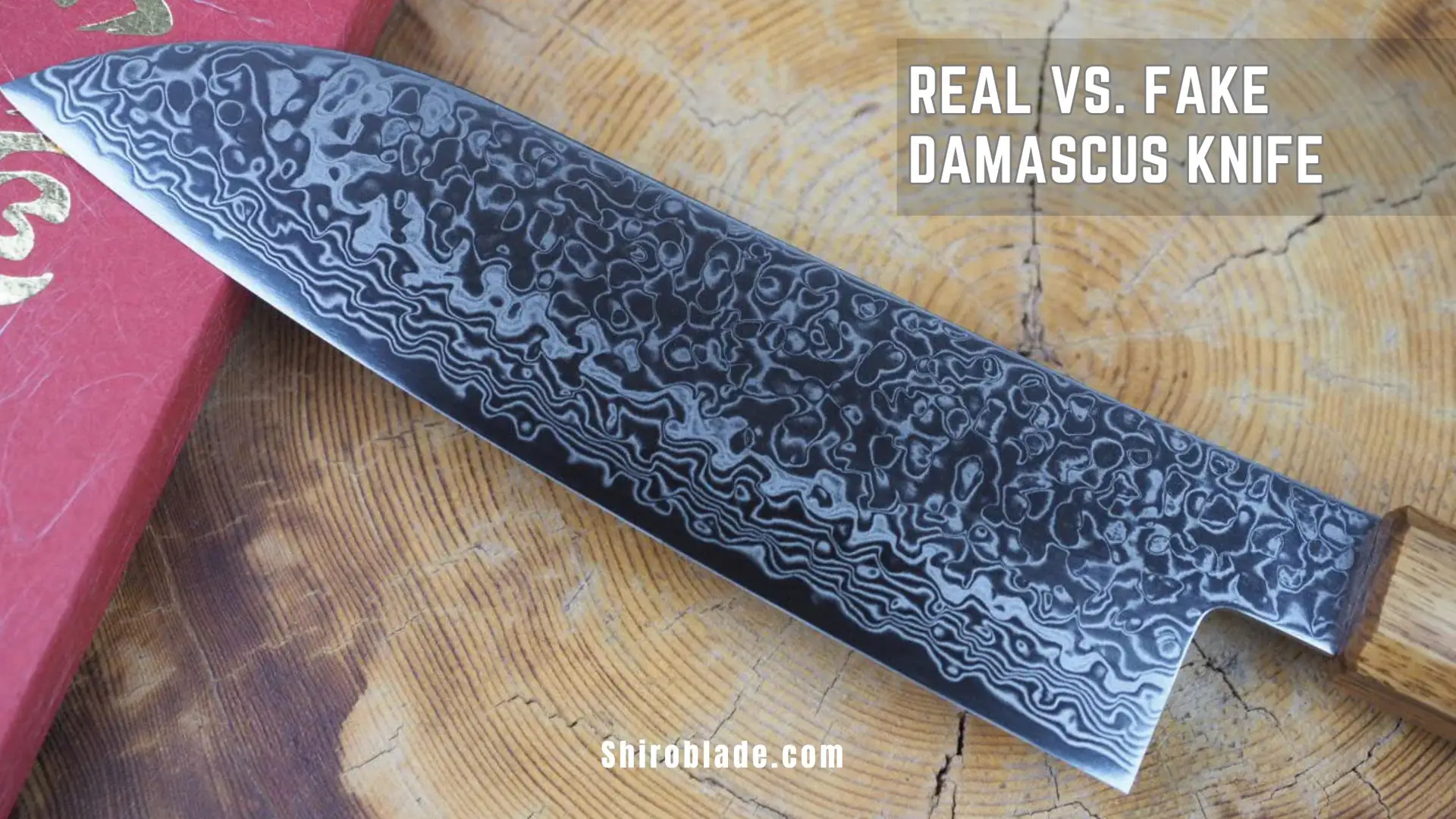
The allure of a Damascus chef knife is undeniable. With its mesmerizing, watery swirls and a reputation for legendary sharpness, it is the crown jewel of any kitchen. However, as the popularity of these blades has surged in India, so has the market for deceptive imitations.
For a buyer in India, navigating marketplaces like Amazon or Flipkart can be a minefield. You see “Damascus” knives ranging from ₹1,500 to ₹45,000. How do you distinguish between a mass-produced piece of scrap metal with a printed pattern and a hand-forged masterpiece from Sakai City?
In this guide, we dive deep into the technical world of pattern-welding, forge-welding, and acid etching to ensure you never fall for a “laser-etched” scam again
6 Ways to Differentiate Real and Fake Damascus Knives
1. Understanding the Forging Process: Pattern-Welding vs. Laser Etching
To identify a fake, you must first understand how a real Damascus knife is made. Authentic modern Damascus is created through pattern-welding. This involves taking different types of steel (usually a high-carbon core like VG10 or Blue Super Steel and layers of softer stainless steel), stacking them into a billet, and forge-welding them together at extreme temperatures.
After the blade is forged and ground, it is dipped into a ferric chloride bath. This is called acid etching. The acid reacts differently to the various layers of steel—darkening the high-carbon layers and leaving the nickel or stainless layers bright. This reveals the Suminagashi (floating ink) pattern.
The Fake Alternative:
A fake Damascus knife is usually just a single piece of cheap stainless steel. Manufacturers use a high-powered laser to burn a pattern onto the surface or use a stencil to silk-screen an acid pattern. There are no layers; there is only a surface-level “tattoo” on the metal.
2. The Spine Test: Searching for Layer Continuity
One of the fastest ways an expert identifies a fake is by looking at the spine (the top, blunt edge) of the knife.
In an authentic Sakai-made or handcrafted Damascus blade, the pattern isn’t just on the “cheeks” of the knife; it is baked into the very DNA of the metal.
Real Damascus:
You should see subtle, irregular lines or layers continuing across the spine and often down into the tang (the part of the blade inside the handle).
Fake Damascus:
The spine is usually perfectly smooth, polished, and solid. Because laser etching is a 2D process applied to the sides, the manufacturer rarely bothers to “wrap” the pattern around the top.
3. The Bevel and Edge Transition
The cutting edge (the bevel) tells a story. When a blacksmith grinds a blade to make it sharp, they are effectively “slicing” through the layers of the steel.
In a genuine Gyuto or Santoku Damascus knife, the pattern will change as it reaches the sharpened bevel. You will see the layers coming together toward the core steel (the “San Mai” construction). The pattern will appear to “melt” or flow into the edge.
The Red Flag:
On a fake, the laser pattern often stops abruptly right before the sharpened edge begins. This is because the laser can only mark the flat surface of the blade. If there is a sharp, straight line where the pattern ends and the shiny steel edge begins, you are likely looking at a fake.
4. Pattern Uniqueness: The Fingerprint Rule
Authentic Damascus is organic. Because it is forged by hand, the movement of the steel under the hammer creates unique variations. Even in high-end production lines like Sakai Takayuki, no two knives will ever have the exact same “fingerprint.”
If you are browsing a website in India and see five different customer photos in the reviews, and every single knife has the exact same raindrop or ladder pattern in the exact same spot, it is a laser print. Real steel has “glitches”—small irregularities in the watery flow that signify human craftsmanship.
5. Price vs. Provenance: The Reality of the Indian Market
We must address the Rockwell Hardness (HRC) and the cost of labor. A genuine Japanese Damascus knife requires:
Premium steel (VG10, AUS-10, or High Carbon).
Expert heat treatment.
Hours of hand-grinding and etching.
In India, importing these blades from Sakai or Seki City involves significant shipping costs and customs duties, which often drive the final retail price higher than expected.
Real Price:
Expect to pay ₹8,000 to ₹45,000 for a legitimate entry-to-mid-level Damascus chef knife.
The “Amazon Price”:
If a knife is listed for ₹1,999, it is physically impossible for it to be real Damascus. The cost of the raw steel billet alone often exceeds that price.
6. The "Sandpaper Test" and Relief Texture
If you already own a knife and are suspicious, you can perform a non-destructive test using high-grit sandpaper (1000+ grit).
Texture:
Run your fingernail across the pattern. On a real etched blade, you can often feel a very slight 3D relief. The acid eats the darker steel faster, leaving the lighter steel slightly raised. A fake is usually glass-smooth.
The Test:
Lightly sand a small, inconspicuous area. A laser-etched pattern will simply rub off, leaving a plain grey surface. On a real Damascus blade, the pattern might dim, but if you were to re-apply an etchant, the pattern would reappear because it exists through the entire thickness of the steel.
Why It Matters: Performance vs. Looks
Why should you care if it’s “real” or “fake” if it looks good? The answer lies in Edge Retention. A fake Damascus knife is usually made of soft 420 or 440 series stainless steel. It will go dull after a week of cutting onions.
A real Sakai-type blade uses a high-carbon core. This allows the knife to be sharpened to a razor-fine angle (12-15 degrees) and stay that way for months. When you buy real Damascus, you aren’t just buying a pattern; you are buying the performance of high-performance metallurgy.
Summary Checklist for Indian Buyers
| Feature | Real Damascus | Fake / Etched Damascus |
|---|---|---|
|
Spine |
Shows visible layers |
Smooth and plain |
|
Edge |
Pattern flows into the bevel |
Pattern stops before the edge |
|
Texture |
Slight 3D feel (relief) |
Completely smooth |
|
Uniqueness |
Every blade is a “fingerprint” |
Identical mass-produced patterns |
|
HRC (Hardness) |
60-62 HRC (Stays sharp) |
52-54 HRC (Dulls quickly) |

Indian knife collector with a deep respect for Japanese knife making. What began as an interest in Damascus patterns grew into a focused study of Japanese knives from Sakai and Seki. Through Shiroblade, I share simple guides on buying, using, and caring for knives, helping readers understand real craftsmanship beyond looks.


Pingback: Damascus Layer Count Explained: Does More Layers Mean a Better Knife?
Pingback: Damascus Layer Count Explained: Does More Layers Mean a Better Knife?
Pingback: The Damascus Blade Patterns Myth: There Is No Such Thing
Great guide! Many people assume that every blade with a Damascus pattern is automatically authentic, but it’s important to understand how real Damascus is made and how pattern-welded steel works. The layered forging process creates the unique patterns while also supporting a hard core steel for cutting performance. Articles like this are really helpful for beginners who want to learn how to recognize genuine craftsmanship instead of just decorative patterns.
Pingback: 7 Best Damascus Knives in India: Top Choices to Buy - ShiroBlade
Pingback: How to Choose a Kitchen Knife in India (Expert Guide)
Pingback: How Much Does a Real Damascus Knife Cost? - ShiroBlade